

Finding the Best Music Promotion Services for Independent Artists
Finding a way to get your music heard can feel like an impossible challenge. The truth is, the best music promotion services aren't a magic bullet. Success comes from picking a strategic partner that actually gets your genre, your goals, and your budget. This guide will show you exactly how to do that.
Your Guide to Navigating Music Promotion
Making great music is only half the job. The other half? Making sure it reaches the right people. In a world where millions of songs are released every month, just uploading your track and hoping for the best is a recipe for failure. This is where music promotion services come in—they’re the bridge between your art and your future fans. They exist to cut through the noise.
Think of it this way: your song is an incredible product, but without marketing, it’s just collecting digital dust on a shelf. A promotion service is your marketing team, running targeted campaigns to get your music in front of people who will actually listen. This guide is your roadmap to understanding how it all works, from the basics to the pro-level strategies that build real careers.
Why Promotion Is Non-Negotiable Today
The modern music industry runs on streaming, and the numbers are mind-blowing. In 2024, the global streaming market hit $33 billion, and it's projected to rocket towards $68 billion by 2029. This explosion is fueled by platforms like Spotify, which is on track to have over 615 million active users in 2025.
Here's the most important part: more than one-third of all listening on Spotify comes from playlists. This gives independent artists a direct line to massive audiences—something that used to be impossible without a major label. You can explore more about this market growth and what it means for artists.
This data paints a very clear picture: getting your track on the right playlists is one of the most powerful moves you can make. A smart campaign can trigger the algorithm, introduce your music to thousands of new listeners, and build momentum that lasts.
Building a Foundation for Success
Before you even start looking at services, you need to understand that promotion is an investment, not a quick fix. The best campaigns are built on a solid understanding of your own project.
Here's what you need to nail down first:
- Your Goals: Are you trying to get immediate buzz for a new single, or are you focused on growing your monthly listeners over the long haul?
- Your Genre: A promotion service that crushes it for EDM producers will have totally different contacts and strategies than one that focuses on indie folk.
- Your Budget: Knowing what you can realistically spend will determine the scale and type of campaign you can run.
The goal isn't just to get streams; it's to build an audience. A successful promotion strategy converts casual listeners into dedicated fans who save your music, follow your profile, and can't wait to hear what you drop next.
Once you have these fundamentals sorted out, you can start figuring out which of the best music promotion services is the right fit to amplify your sound and build a real presence in the industry.
Understanding the Different Types of Music Promotion
Trying to figure out music promotion can feel overwhelming. There are so many options, and it’s easy to get lost in the noise. The trick is to understand that each type of service is a different tool for a specific job. Picking the right one comes down to your goals, your genre, and where you are in your career.
Think of your promotion strategy like building a team. You wouldn’t hire a team where everyone has the same skill. The best campaigns mix different promotional elements to cover all the bases. Let's break down the main players so you know who to put on your team.
DSP Growth and Playlist Pitching
This is the new radio. Forget waiting for a DJ to spin your track—the real power now lies with Digital Service Providers (DSPs) like Spotify, Apple Music, and TIDAL. Playlists on these platforms are the number one way people find new artists. A service focused on this area works to get your music onto influential, genre-specific playlists run by real curators.
These placements accomplish two huge things:
- Instant Exposure: Your track gets put directly into the ears of thousands of potential fans who are already listening to music just like yours.
- Algorithmic Fuel: When listeners save your track, add it to their own playlists, or follow your artist profile, it sends a powerful signal to Spotify's algorithm. This is what can trigger placements on massive algorithmic playlists like Discover Weekly and Release Radar, which is how a small campaign can snowball into major organic growth.
For artists who want to build a real listener base and see their streaming numbers climb, this is almost always the best place to start. You can dive deeper into the nuts and bolts of how to promote your music on Spotify to really get ahead of the game.
The diagram below shows how your sound, goals, and budget all have to work together to build a solid foundation for your promotion.
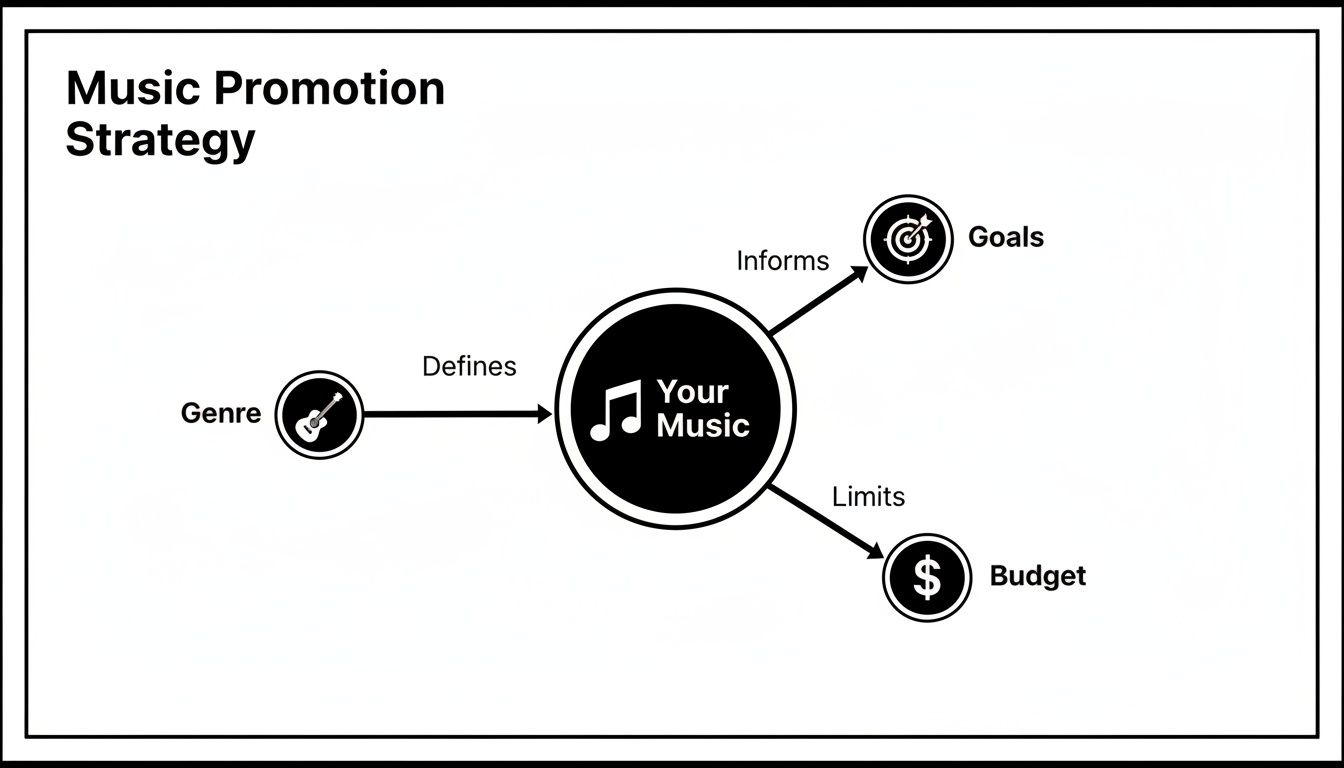
As you can see, a successful campaign isn't just about throwing money at the wall and seeing what sticks. It’s a calculated plan that connects every move back to your core identity and what you want to achieve.
To make it even clearer, here's a simple breakdown of how the different promotion types stack up against each other.
Comparing Music Promotion Service Types
| Service Type | Primary Goal | Key Platforms | Best For Artists Who... |
|---|---|---|---|
| Playlist Pitching & DSP | Increase streams, build a listener base, trigger algorithms | Spotify, Apple Music, TIDAL, Amazon Music | Are ready to grow their monthly listeners and want tangible results. |
| Press & Radio | Build industry credibility and brand reputation | Music blogs, online magazines, digital/FM radio | Have a strong story and are looking to build long-term career assets. |
| Social Media & TikTok | Achieve viral discovery and rapid audience growth | TikTok, Instagram Reels, YouTube Shorts | Have catchy, trend-worthy tracks and want massive, fast exposure. |
| Digital Ads | Drive targeted traffic and convert listeners into followers | Instagram/Facebook Ads, YouTube Ads, Google Ads | Have a clear target audience and a budget for direct-to-fan marketing. |
Each of these channels plays a unique role, and the most powerful strategies often combine at least two of them to create momentum.
Traditional Press and Radio Campaigns
While DSPs drive the numbers, traditional media is still king when it comes to building credibility. This is all about getting features, reviews, and interviews in music blogs, online zines, and on radio shows. It’s less about chasing immediate stream counts and more about building your story.
A great review from a respected blog or a spin on a cool indie radio station is like a badge of honor. It's social proof. This is the kind of stuff you put in your electronic press kit (EPK) to help you land better gigs, brand deals, or even get a label’s attention. Think of this as a long-term investment in your brand.
Social Media and TikTok Promotion
If playlisting is the new radio, then social media is the new word-of-mouth—on steroids. Platforms like TikTok, Instagram Reels, and YouTube Shorts are discovery machines that can launch a 15-second soundbite into a global phenomenon. A promotion service in this lane connects your music with influencers and creators who can introduce it to their millions of followers.
The name of the game here is virality. One video blowing up can lead to a tidal wave of Shazams, a massive spike in streams, and a flood of new followers overnight. This is the perfect strategy for artists whose songs have a catchy, memorable hook that can easily be used in a dance, a trend, or a meme.
How to Choose a Reputable Promotion Partner
Let's be real: navigating the world of music promotion can feel like walking through a minefield. For every legit service trying to help artists grow, there are dozens of shady operations selling fake streams and empty promises. Choosing the right partner isn't just about getting results; it's about protecting your career, your money, and your reputation.
The key is to look past the flashy websites and five-star testimonials. You need a simple, practical way to vet potential partners. A trustworthy company will be totally open about its methods, give you realistic expectations, and show you data that proves they’re doing their job. This puts you in control.
Red Flags Versus Green Lights
Your first job is learning how to spot a scam from a mile away. Most of these predatory services use the same old tricks to lure in artists, but once you know what to look for, they’re pretty easy to see through.
Here are the biggest red flags to watch out for:
- Guaranteed Placements: Nobody can guarantee you a spot on a major Spotify editorial playlist. Period. Those are controlled 100% by Spotify’s internal team. If someone promises you a slot on "RapCaviar" or "Today's Top Hits," run.
- Vague Methods: If a company gets cagey when you ask how they pitch your music, that's a problem. Phrases like "proprietary network" or "secret algorithm" with no other explanation are often just fancy words for bot farms.
- Insanely Low Prices: Look, everyone loves a good deal. But if a service offers tens of thousands of streams for just a few bucks, it's a scam. Generating real plays costs real money, and those prices are a dead giveaway that they're using bots.
On the flip side, green lights are signs of a partner you can trust. Look for services that have detailed case studies, real reviews on third-party sites, and are happy to jump on a call to talk about their process. Transparency is everything.
Questions You Must Ask a Promotion Service
Before you even think about spending a dime, you need to ask some direct questions. A good company will welcome this. They'll see it as a chance to show you they know their stuff. Think of it like an interview—you're hiring them for a critical role.
Here’s your checklist of must-ask questions:
- What is your exact process for pitching music? Do they use email, submission forms, or direct relationships? Get specific.
- How do you vet the playlists in your network? They need a clear system for checking playlists for fake followers and bot activity. This protects you.
- Can you show me case studies from artists in my genre? Getting results for a pop artist doesn't mean they can help a lo-fi producer. You need proof they understand your sound and your audience.
- What metrics should I be tracking in my Spotify for Artists account? A real pro will tell you to look beyond just stream counts. They’ll point you to your save rate, listener-to-follower ratio, and the "Source of Streams" tab.
A focus on specialists can also be a significant advantage. A service that concentrates solely on Spotify growth, for instance, often has deeper, more established relationships with playlist curators in that specific ecosystem. This specialized knowledge can lead to more effective and better-targeted campaigns compared to a generalist agency trying to cover all platforms at once.
Finally, if you're building a bigger campaign that includes PR, do your homework on services that specialize in that area. It's always worth exploring in-depth comparisons, like these 12 Best Press Release Distribution Service Choices, to really understand your options. This kind of diligence ensures every piece of your promotion is handled by an expert, giving you the best shot at success.
Building Your Campaign for Maximum Impact
Alright, let's move from theory to action. This is where the real work begins. A killer campaign isn’t about just throwing money at every service you see. It’s about being smart and strategic, making every dollar count based on what you actually want to achieve.
Think of it like this: your budget is the gas in the tank, and your goal is the destination. You need a map.
A campaign to launch a brand-new single is going to look completely different from one designed to get more ears on your existing catalog. The new single needs a big, explosive push right out of the gate to make a splash. An audience growth campaign, on the other hand, is a slow burn—it's about consistently feeding the algorithm over weeks or months.
One is a sprint, the other is a marathon. You can't train for both the same way.
Structuring Your Campaign Based on Goals
Let's walk through two of the most common scenarios artists face. Getting these frameworks right will help you pinpoint the best music promotion services for what you need to do.
Scenario 1: The New Single Launch
The goal here is simple: maximum impact in a very short window, usually the first 2-4 weeks after your track drops. You need to create buzz, get Spotify's algorithm to notice you, and turn those first-time listeners into followers. Fast.
A smart budget split for this looks something like:
- 70% to Spotify Playlist Pitching: This is your heavy hitter. You want to get your track into as many high-engagement, genre-matched playlists as possible. This drives quality streams and sends a powerful signal to Spotify that your song is catching on.
- 30% to a TikTok Influencer Push: This is your shot at going viral. Getting your hook in front of a massive audience through a few key influencers can drive a ton of Shazams, saves, and streams. For artists who want to scale this, digging into an ultimate guide to TikTok automation for effortless growth and monetization is a smart move.
Scenario 2: The Audience Growth Campaign
With this goal, you're playing the long game. You want to see a steady, month-over-month increase in your listeners and followers. This is perfect for artists who have a back catalog and want to build a real, sustainable fanbase.
Here, the budget allocation shifts completely:
- 100% to Sustained Playlist Pitching: Instead of one massive push, you spread your budget out over several months. The focus shifts to securing placements in smaller, niche playlists that deliver a consistent trickle of new listeners. This keeps your tracks active and tells the algorithm your music has staying power.
This isn't just about spending money—it's about investing it. When you're strategic, your promotional spend becomes a predictable tool for growing your career.
Sample Budgets and Realistic Outcomes
So, what can you actually expect for your money? Let’s be real about it. These outcomes are based on what you can achieve with a legit, organic-focused service—like the specialized Spotify packages we run here at Club Restricted Promo.
-
The Emerging Artist ($500 Budget): This is a solid starting point for a single. The goal is to land on a handful of quality micro-to-mid-tier playlists. Realistic Outcome: Several thousand new, targeted streams, a nice bump in your monthly listeners, and—most importantly—data on which playlists your sound connects with.
-
The Serious Contender ($1,500 Budget): With this kind of budget, you can get much more aggressive. You can target a wider net of larger, more influential playlists and maybe even run some targeted social ads to pour fuel on the fire. Realistic Outcome: Tens of thousands of streams, a big jump in listeners and followers, and a very real shot at triggering algorithmic playlists like Discover Weekly.
-
The Established Artist ($3,000+ Budget): Now you can run a full-blown, multi-channel campaign. This means top-tier playlist pitching, a coordinated TikTok campaign with several influencers, and even some PR to get your name on key blogs. Realistic Outcome: The potential for over 100,000+ streams, massive audience growth, and the kind of momentum that gets industry gatekeepers to pay attention. Dive into some of the top music promotion strategies that actually work to see how to really maximize an investment at this level.
Measuring Success Beyond Just Stream Counts
It’s way too easy to get hooked on one number: the total stream count. Watching it go up feels great, but that number is just one piece of the puzzle. Real, lasting career growth isn’t about plays—it’s about building a real audience.
The single most important shift an artist can make is moving from a "buying streams" mindset to one of "investing in listeners." This is where your Spotify for Artists data becomes your superpower. It shows you the story behind the numbers and tells you if your promotion partner is actually delivering quality.
Think about it: 10,000 streams from a super-engaged, genre-specific playlist are worth so much more than 100,000 passive plays from a junk source. Why? Because real listeners take actions that feed the algorithm and build momentum for the long haul.
Key Performance Indicators That Actually Matter
When you're judging how well a campaign from one of the best music promotion services is doing, you have to look at the metrics that signal a genuine fan connection. These are the stats that tell Spotify your music is hitting the mark, which can trigger powerful organic discovery.
Here are the top three metrics to watch in your Spotify for Artists dashboard:
-
Save Rate: This is arguably the most powerful signal you can send to the algorithm. When someone saves your track to their library or adds it to one of their own playlists, it’s a huge vote of confidence. A high save rate tells Spotify your music is worth showing to more people.
-
Listener-to-Follower Conversion: Streams come and go, but followers are the fans who get notified about your next release. Tracking how many listeners hit that "Follow" button is a critical measure of audience growth. A good campaign doesn't just bring you listeners; it brings you fans.
-
Source of Streams: This tab is your truth detector. It shows you exactly where your plays are coming from—whether it's editorial playlists, algorithmic ones like Discover Weekly, or user-curated playlists. If a campaign is working, you'll see a big chunk of streams coming from the playlists you were pitched to.
When your artist profile is healthy and your data tells a story of genuine engagement, you become more attractive to the entire industry. This includes booking agents, sync licensing supervisors, and label A&Rs who all look for these indicators of a dedicated fanbase.
Turning Data Into Long-Term Career Growth
Digging into these deeper metrics does more than just confirm a single campaign was worth it; it gives you a roadmap for your entire career. For example, if you see a high save rate from a specific niche playlist, you know exactly what kind of audience to target for your next release. This data-first approach takes out the guesswork and makes your marketing budget work smarter.
Plus, a strong streaming profile can open up other major revenue streams. Sync licensing—getting your music placed in films, TV, or ads—is a perfect example. This space is exploding, with global revenues expected to hit up to $650 million by 2025. Smart promo services often blend sync strategies with their playlisting, knowing that a track with solid engagement data is far more likely to grab a music supervisor's attention.
At the end of the day, every metric should be viewed through one lens: building a loyal community around your music. A verified artist profile is the foundation of this community, signaling to listeners that you're a serious artist. If you haven't done it yet, getting verified is a crucial first move. You can find a complete walkthrough in our guide on how to get verified on Spotify. This small step adds a layer of professionalism that makes all your promotional efforts more effective.
Frequently Asked Questions About Music Promotion
Even after you've mapped out a release, some questions always seem to pop up. Think of this as your quick-reference guide for the most common things we hear from artists every day. Getting straight answers is the key to making smart decisions and putting your money where it counts.
Let’s cut through the noise and tackle these head-on.
How Much Should I Budget for Music Promotion?
This is the big one, but the answer is simpler than you think. Your budget should line up with where you are in your career and what you want this release to achieve. There’s no magic number, but there are some solid benchmarks.
For a new artist dropping a single, a budget between $500 and $1,500 is a great place to start. That’s enough to fund a serious, targeted playlist pitching campaign and maybe even a small social media push. It gives you enough fuel to get real data and build that first wave of momentum.
Artists with more of a footprint might invest anywhere from $3,000 to $10,000+ on a major release. That kind of budget can support a full-scale campaign covering top-tier playlisting, press outreach, and a multi-influencer TikTok strategy.
The most important mindset shift? Every dollar you spend is an investment in your audience and your data, not just a cost. Every campaign, big or small, teaches you something that makes the next one even smarter.
Can Promotion Services Guarantee Playlist Placements?
A hard and fast no. Any service that "guarantees" you a spot on a major playlist, especially an official Spotify editorial like "Today's Top Hits," is a massive red flag. Those lists are controlled 100% by internal editorial teams. They can't be bought.
"Guarantees" are the signature move of bot farms and pay-for-play scams that will wreck your artist profile and can even get your music blacklisted from the platform.
So, what are you actually paying for with a legitimate service?
- Expertise and Strategy: Their knowledge of what works and their ability to build a campaign that fits your sound.
- Relationships and Outreach: You're tapping into their network of real, vetted playlist curators.
- Time and Effort: They do the hundreds of hours of research, pitching, and follow-up that a real campaign requires.
A reputable service guarantees their effort and their process—not a specific result. They promise to get your music in front of the right people, giving you the best possible shot at getting picked up.
How Long Does It Take to See Results?
Patience is everything in music promotion. Real, sustainable growth doesn't happen overnight, and the timeline really depends on the type of campaign you're running.
With Spotify playlist pitching, you'll often see the first adds within 7 to 10 days after launch. The real momentum usually builds over the next 2-4 weeks as more curators discover the track and listener data starts rolling in.
Social media and TikTok campaigns can pop off almost instantly. A video can go viral in hours, but that initial buzz can be short-lived if it doesn't spark a bigger trend.
On the other hand, traditional press and radio campaigns are a long game. These require 4-8 weeks of pitching before your release date to line up features and interviews that drop alongside your music. Growth is a marathon, not a sprint.
What Is the Difference Between Algorithmic and Editorial Playlists?
Nailing this distinction is crucial to understanding the Spotify ecosystem. They both drive streams, but they are two completely different animals.
Editorial Playlists are the big, brand-name lists like "RapCaviar" or "Indie Pop." They are 100% hand-curated by Spotify's internal team of music experts. Landing on one is the ultimate goal, but it's incredibly competitive and mostly out of your hands.
Algorithmic Playlists, like "Discover Weekly" and "Release Radar," are unique to every single user. They are generated automatically by Spotify’s algorithm based on a listener's personal taste and habits. It's pure data in action.
This is exactly where the best music promotion services make their mark. The core strategy is to get your track onto influential, high-engagement user-curated playlists. When listeners on those playlists save your track, follow your profile, or add the song to their own libraries, they send powerful positive signals to Spotify. This is the engagement that triggers the algorithm to place your song into thousands of algorithmic playlists, kicking off a powerful cycle of organic discovery that builds a real, lasting audience.
Ready to turn these insights into action? Club Restricted Promo specializes in building strategic Spotify campaigns that deliver real, organic growth. Explore our packages and start building your audience today.