

Unlock free spotify playlists submission: Pitch, Promote, and Get Real Streams
Trying to land a free Spotify playlists submission is about way more than just firing off a bunch of emails. It all starts with how you present yourself. Curators, whether they're running massive independent playlists or working inside Spotify's editorial team, are looking for the total package: broadcast-ready audio, killer artwork, and a Spotify profile that says you're serious.
Laying the Groundwork for Playlist Success
Before you even think about writing a pitch, your online presence has to do the heavy lifting for you. Your Spotify profile is your digital business card. When a curator clicks on your name, they need to see an artist who’s ready for prime time. That first impression often decides whether your track even gets a listen.
A solid pre-submission game plan boils down to three core things: pro-level audio, eye-catching visuals, and a complete artist profile. Each piece builds on the others to create credibility and convince curators that your music is worth their time—and their audience's. If you drop the ball on any of these, you're hurting your chances before you even start.
Nail Your Audio and Visuals
First things first: your track has to sound incredible. That means investing in professional mixing and mastering. No shortcuts. Your song is going to be sitting right next to major label artists with massive budgets, and it needs to compete sonically. A track that sounds muddy, thin, or isn't loud enough will stand out for all the wrong reasons.
Just as important is your cover art. Think about it—in an endless scroll, your artwork is the very first thing that grabs someone's attention. It must be high-resolution, visually compelling, and match the vibe of your music. Generic or low-quality art just signals a lack of effort and can make your whole project feel amateur.
This flow chart breaks down the essentials.
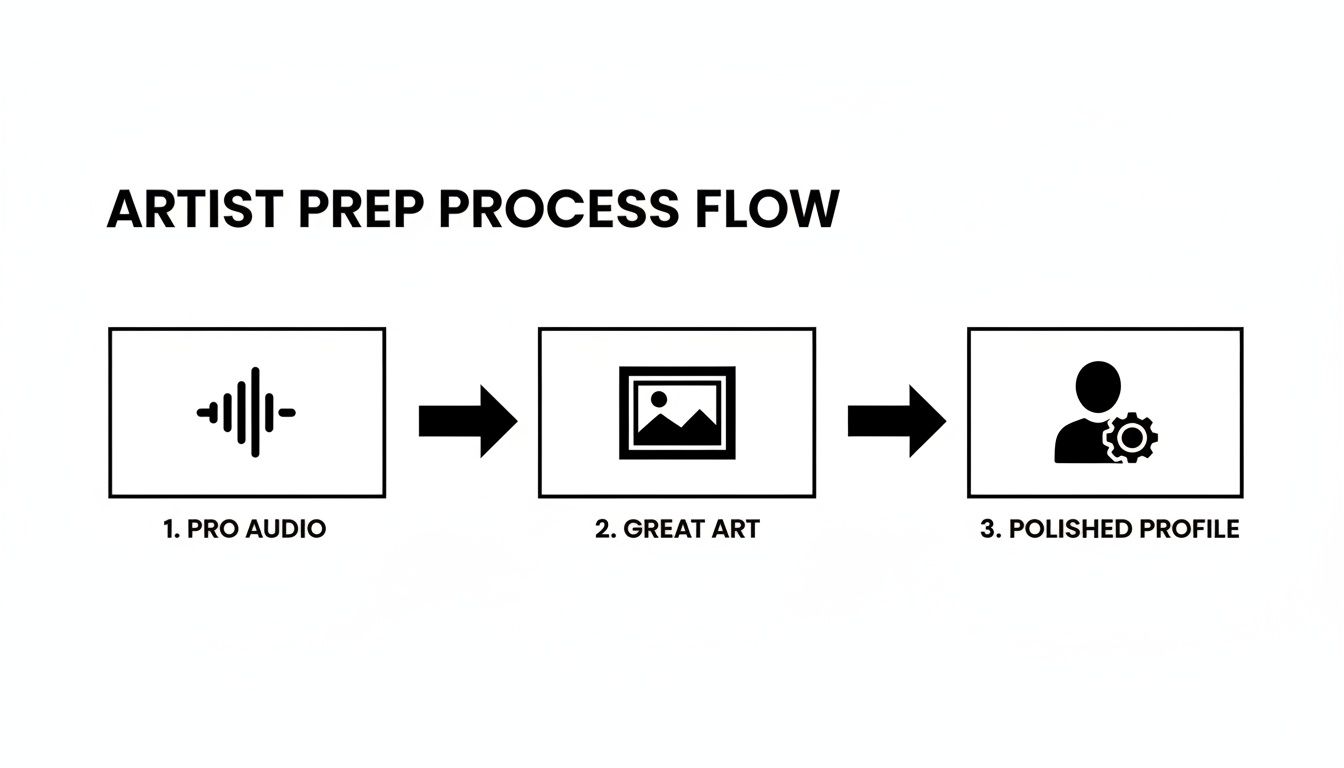
It’s a simple reminder that a polished profile is just as critical as the music and the art.
Optimize Your Spotify for Artists Profile
Your Spotify for Artists account is your home base. A complete, well-managed profile isn't just a nice-to-have; it's a non-negotiable.
Here’s a quick checklist of what you need to lock in:
- Artist Bio: Tell your story. Who are you? What drives your music? Keep it short but make it interesting. Give curators a reason to connect with you beyond the track.
- High-Resolution Photos: Upload a few professional press shots. Your main profile picture and header need to be sharp and reflect your brand.
- Social Media Links: Connect your Instagram, TikTok, Twitter, and anything else you're active on. Make it easy for curators and new fans to find you everywhere.
- Artist Pick: This is prime real estate. Use it to highlight your new single, a playlist you're featured on, or another song you want to push.
Your Spotify profile is your digital handshake. A verified account with a sharp bio, great photos, and a clear brand story turns a curator's casual glance into genuine interest.
Getting that blue checkmark by claiming your profile is a huge first step. If you haven't done it yet, our guide on how to get verified on Spotify will walk you through it. A verified profile immediately builds trust and signals that you're an active, professional artist.
Using the Official Spotify for Artists Pitch Tool
While hunting for independent curators is a smart move, don't overlook your single most important free submission: the one you send directly to Spotify.
The Spotify for Artists pitch tool is your only direct line to their official editorial team. These are the people building career-making playlists like New Music Friday, Indie Pop, and Chill Vibes. Best of all, using it costs you nothing but a bit of time and effort.
Think of it less as a submission form and more as a critical data-gathering tool for Spotify. Every detail you provide helps their algorithm understand where your music fits in the vast ocean of new releases. Getting this right can be the difference between getting lost and getting discovered by millions.
Timing Is Everything
The biggest mistake I see artists make? Submitting their track way too late. You absolutely cannot pitch a song that has already been released.
To give editors a real chance to listen, you need to submit your track through the Spotify for Artists dashboard at least one to two weeks before your official release date.
But if you want to play like the pros, aim earlier. Pitching your track three to four weeks in advance is the real sweet spot. It gives you a comfortable buffer and signals to the editorial team that you're organized, professional, and serious about your release campaign.
Pro Tip: Pitching your unreleased track also automatically gets your song into your followers' Release Radar playlists on release day. This is a guaranteed boost, so never, ever skip this step, even if an editorial placement feels like a long shot.
Crafting the Perfect Pitch
Your pitch is where you sell the story behind the song. You're limited to 500 characters, so every single word counts. Be concise, be personal, and be compelling.
Editors read hundreds of these a day. Make yours stand out by giving them context and a reason to care.
Your pitch should cover a few key things:
- The Story: What’s the inspiration? Is there a unique backstory to how it was made?
- The Vibe: Describe the mood. Instead of just saying "it's a sad song," try something like "it’s a track for late-night drives after a tough breakup."
- Your Plans: Briefly mention any marketing you have lined up, like a music video, a social media campaign, or upcoming shows. This shows you’re all-in on promoting it.
A huge part of this process is tagging your track with the right metadata. You’ll be asked to select genres, sub-genres, moods, and even specific instruments. Be as accurate as you can. If your song has a killer saxophone solo, tag it. This data is exactly what helps the algorithm serve your song to the right listeners.
To help you stay on track, I've put together a simple timeline and checklist.
Editorial Pitching Timeline and Checklist
Following this checklist ensures you’re not scrambling at the last minute and that every part of your pitch is buttoned up and professional.
| Timeframe Before Release | Action Item | Pro Tip |
|---|---|---|
| 4 Weeks Out | Upload your final track & artwork to your distributor. | Do this as early as possible. Some distributors take a few days for the track to appear in your S4A dashboard. |
| 3 Weeks Out | Log into Spotify for Artists and open the pitch tool. | Make sure your artist profile (bio, photos, social links) is fully updated before you start the pitch. |
| 3 Weeks Out | Draft your 500-character pitch. | Write it in a separate doc first. Read it out loud to make sure it sounds natural and compelling. |
| 2-3 Weeks Out | Complete all metadata tags (genres, moods, etc.). | Be specific and honest. Don't tag "Happy" if it's a breakup anthem, even if you think it has wider appeal. |
| 2 Weeks Out (Latest) | Submit your final pitch. | Double-check everything for typos. Once it's submitted, you can't edit it. |
| Release Week | Check your S4A for any playlist adds. | Placements can happen on release day or even a few days after. Keep an eye on your stats. |
This simple process can make a world of difference.
By treating the official pitch tool with the seriousness it deserves, you’re using a powerful, free resource that could put your music on a global stage. For a deeper dive, check out our complete guide on how to promote your music on Spotify. It’s a foundational step in any successful release.
How to Find and Vet Independent Curators
While Spotify's official pitch tool is a great starting point, the real magic often happens within the massive, decentralized network of independent curators. These are the music lovers and tastemakers who build loyal followings around niche genres and specific moods.
Landing a spot on the right independent playlist can be a game-changer for your track's momentum. The trick is knowing where to find these curators and, more importantly, how to tell the genuine ones from the fakes. This isn't about buying a placement; it's about doing smart detective work.
A free spotify playlists submission to a well-managed, engaged independent playlist can easily outperform a paid spot on a list full of bots. The goal is to connect with real people who will actually listen to and appreciate your music.
Uncovering Legitimate Playlist Opportunities
One of the most effective ways to find curators for free is to reverse-engineer the success of artists who share your sound.
Find a few artists in your genre who are a few steps ahead of you in their career. Go to their Spotify profile, scroll down, and look for the "Discovered On" section. This little-known feature is a goldmine of active playlists that have already shown interest in music like yours.
Click through those playlists. If a curator has dropped a link to their social media or a submission website in the playlist description, you've found a solid lead.
Social media is also your best friend here:
- Instagram & X (formerly Twitter): Run targeted searches like "indie pop playlist curator," "chill lofi spotify playlist," or "workout music submission."
- Reddit: Subreddits like r/SpotifyPlaylists can yield some results, but you'll have to filter through a lot of self-promo to find the real submission calls.
Vetting Playlists to Avoid Scams
So, you've got a list of potential playlists. Now comes the most critical part: vetting. Not all playlists are created equal. Many are just ghost ships full of bots that deliver zero real engagement. Globally, with Spotify's 696 million listeners, playlist dominance underscores why free submissions to hyper-relevant lists—found via tools analyzing 79 million playlists and 250 billion data points—can catapult indie tracks into viral territory. You can discover more insights about playlist data on Soundcamps.
Here’s a quick checklist to spot a healthy, engaged playlist:
- Check the Curator's Profile: Does the curator's Spotify profile link out to active social media accounts? A real person or brand behind the playlist is a fantastic sign.
- Analyze Follower Growth: Use a third-party tool to check the playlist's follower history. If you see sudden, massive jumps in followers, they were almost certainly purchased.
- Look at Other Artists: Do the other artists on the list have a similar monthly listener count? If a playlist with 50,000 followers is packed with artists who all have under 1,000 monthly listeners, that's a huge red flag for bot activity.
A healthy playlist shows consistent, organic growth and features a mix of both emerging and established artists. If it feels too good to be true—like a brand-new artist landing on a list with millions of followers—it probably is.
This vetting process is non-negotiable. It protects your music from fake streams and ensures your hard work is focused on reaching actual listeners who could become fans.
For a deeper dive into what separates high-impact playlists from the rest, our guide on the best Spotify playlist promotion services breaks down what to look for. A little diligence upfront ensures every free spotify playlists submission you make has the best possible chance to succeed.
Writing an Outreach Email That Actually Gets a Reply
Finding the right independent curators is only half the battle. Your outreach email is the moment of truth—it's what convinces a busy curator to stop scrolling through their flooded inbox and actually listen to your music.
Let’s be real: a generic, copy-pasted message is the fastest way to get your email deleted. To make any kind of impact, your pitch needs to be personal, professional, and straight to the point. A single, well-crafted message sent to the right person will always outperform a hundred generic email blasts. Your goal is to show you respect their time and have a genuine appreciation for the playlist they've built.
The Anatomy of a Perfect Pitch
Every successful outreach email has a few key ingredients designed to grab attention and make it easy for the curator to say "yes."
- A Compelling Subject Line: Be clear and concise. Mentioning the playlist name shows you've done your homework. Something simple like "Submission for your 'Midnight Lofi' playlist" works perfectly.
- A Personalized Opener: Start by mentioning their playlist by name and drop a quick, genuine compliment. A line like, "I'm a big fan of your 'Midnight Lofi' playlist, especially the way you blend jazzy instrumentals with chill beats," proves you’re a real listener.
- The Quick Pitch: Briefly introduce yourself and your track. The secret sauce? Compare your sound to one or two artists already on their playlist to give them an immediate reference point. Keep this part to one or two sentences, max.
- The All-Important Link: Provide a single, direct streaming link. Spotify is always best. Avoid sending attachments or links to platforms that require a login or any extra clicks.
And the golden rule? Keep your entire email under 100 words. Short, scannable emails are far more likely to get a full read-through from a busy curator.
Remember, the goal of your initial email isn't to tell your life story. It's to pique their interest enough to click the link and listen to your track. Let the music do the heavy lifting.
Real-World Examples: Good vs. Bad
Let's look at how a little personalization makes all the difference.
The Bad Pitch (Generic & Lazy): "Hey, check out my new song. I think it would be a good fit for your playlist. Let me know what you think. [Link]"
This email screams spam. It’s impersonal, provides no context, and shows zero respect for the curator's work. Instant delete.
The Good Pitch (Personal & Professional): "Hi Alex, Hope you're having a great week. I'm a big fan of your 'Indie Drift' playlist and have had it on repeat. My new single, 'Sunset Drive,' has a similar dreamy vibe to artists like Dayglow and The Marías that I noticed you feature. I think your listeners would really connect with it. You can listen here: [Spotify Link]. Thanks for your time and consideration! Best, Jane"
See the difference? This version is respectful, specific, and makes the curator’s job easy. It shows a genuine connection and provides a clear reason why the track is a perfect fit.
For a quick reference, here are the core do's and don'ts when writing your pitch.
Outreach Email Do's and Don'ts
| Do | Don't |
|---|---|
| Personalize every email | Send a generic, mass email blast |
| Keep it under 100 words | Write a long, detailed bio |
| Include one Spotify link | Send file attachments or multiple links |
| Mention their playlist by name | Use vague phrases like "your playlist" |
| Compare your sound to artists they feature | Say "my music sounds like nothing else" |
| Follow up once, politely, after a week | Spam their inbox daily |
Sticking to these simple rules will dramatically improve your chances.
Even with a perfectly targeted approach, remember that success isn't guaranteed. For free submission strategies, success rates typically hover around 10-14% on average—meaning you might land one spot for every eight or so submissions. You can read the full research about submission success rates to get a better handle on realistic expectations.
By putting in the effort to write personalized emails, you drastically improve your odds and, just as importantly, build a reputation as a professional artist that curators actually want to work with.
Turning Placements Into Long-Term Relationships
Getting your track on a playlist is a huge win, but don’t stop there. This isn't the finish line—it's the start of a conversation. The smartest artists use a placement as an opportunity to build a real connection that can pay off for years to come.
First things first, you need to see what's actually working. Your Spotify for Artists dashboard is your best friend here. Head over to the "Playlists" tab and dig into the data. You’re not just looking for a big stream count; you want to see which lists are actually driving saves, new followers, and adds to people's personal libraries.
A playlist with 5,000 followers that gets you 1,000 streams and 100 new fans is way more valuable than a list with 50,000 followers that barely moves the needle. The data tells you which curators have a real, engaged audience that actually digs your music.
Nurturing That Curator Connection
Once you've pinpointed the playlists making a real impact, it's time to build a bridge. The goal is to be supportive and appreciative without being annoying. A simple, genuine thank-you can go a long way and keep you on their radar for your next single.
Just send a quick thank-you note. A short email or a DM on social media is perfect.
Here are a few easy ways to show you appreciate the support:
- Share Their Playlist: Post a link to the playlist on your socials. Make sure to tag the curator and thank them publicly for adding your song. This drives traffic back to them, and they always appreciate that.
- Engage with Their Stuff: Follow them on social media and actually interact with what they post. It shows you care about what they're doing beyond just getting a spot on their list.
- Keep Them in the Loop (But Don't Spam): When your next release is coming up, you can hit them up again. A quick reminder of your last placement helps: "You were kind enough to add my last track, 'Sunset Drive,' to your list..."
This simple stuff positions you as a professional artist they want to work with, not just another person asking for a favor.
A quick "thank you" and a social media shout-out are two of the most underrated networking tools in the game. Curators remember artists who support their work, making them far more likely to feature you again.
Building these relationships is the real secret to sustainable growth on Spotify. We saw a campaign where a free trial package reached 100K followers, landed 23 placements, and drove 62,939 streams for just $0.01 per stream. It shows what's possible when you find the right connections. You can see more about how these campaigns work.
By turning a successful free spotify playlists submission into a genuine connection, you build a network of people who are actually invested in seeing you win.
Frequently Asked Questions About Playlist Submission
Diving into the world of free spotify playlists submission is going to bring up a lot of questions. It's totally normal. From wondering about response times to figuring out how to dodge scams, getting clear answers lets you put your energy where it actually counts.
Let's cut through the noise and tackle the most common questions artists run into. This whole process is a marathon, not a sprint, and knowing what to expect will make you a much smarter promoter of your own music.
How Long Should I Wait For a Response?
Patience is probably the most underrated skill in the playlisting game. When you pitch to Spotify's official editorial team, you're not going to get a direct "no." The placement is the notification. If your release day comes and goes without seeing your track on an editorial list, it's safe to move on and assume it wasn't a fit this time around.
For independent curators, it's the wild west. Some might get back to you in a few hours, others could take weeks, and honestly, most just won't reply at all. That's just how it is.
A good rule of thumb? Send one polite follow-up email about two weeks after your first pitch if you haven't heard anything. But don't get hung up on one submission. Your best bet is to build a steady workflow of sending out new, personalized pitches to a bunch of different curators.
What Are the Biggest Red Flags of a Fake Playlist?
Protecting your music and your Spotify account from bot activity is non-negotiable. A fake placement doesn't just give you zero real listeners—it can actively damage your standing with Spotify. Learning to spot the warning signs will save you a world of trouble.
Keep a close eye out for these massive red flags:
- Guaranteed Placements for a Fee: If a curator asks you to pay for a submission or guarantees you a spot, run. This is almost always a scam and it’s a direct violation of Spotify's terms of service.
- Suspicious Follower Counts: Check out the playlists. See a list with 50,000 followers where every artist has just a few hundred monthly listeners? That math doesn't add up and usually points to bot followers.
- No Curator Presence: Real curators are typically proud of their work. They have a real profile, often linking out to active social media accounts. An anonymous, faceless curator is a bad sign.
Trust your gut. If a playlist's numbers look way too good to be true—like an artist with 500 monthly listeners somehow landing on a list with a million followers—it probably is.
Can I Submit a Song That Has Already Been Released?
Yes, absolutely! This is a huge one. While the official Spotify for Artists pitch tool is only for unreleased music, you can and should be pitching your released tracks to independent curators.
This is a core part of any long-term promo strategy. A great song doesn't have an expiration date. You can always circle back to tracks in your catalog that might fit a new seasonal trend, a current event, or a niche playlist you just discovered. Keep finding new ears for your best work.
Ready to take your music promotion to the next level? Club Restricted Promo offers professional campaigns designed to connect your music with real, engaged listeners. Explore our Spotify promotion packages today and start building real momentum.