

Empower Your Career with independent music promotions: Spotify Growth & More
A killer promotion campaign starts long before you ever hit "publish." Too many artists get this backward. They drop a track and then think about marketing. The real secret is laying the groundwork weeks in advance to build a compelling brand, nail down all the boring-but-essential registrations, and get your press kit looking sharp.
This pre-launch phase is what separates a track that makes noise from one that just becomes noise.
Building Your Foundation for a Strong Release
Think of your release like a product launch. You wouldn't just drop a new product in a store with no prep, right? Same goes for your music. The work you do in the weeks leading up to release day determines whether you have a fighting chance to cut through the clutter. It's about building a whole world around your song that invites listeners, bloggers, and DJs to step inside.
And honestly, there's never been a better time to do it yourself. The independent music scene is absolutely booming. Global revenues for indie publishers smashed €2.57 billion in 2023—that's a jaw-dropping 105.6% increase since 2018. The proof is in the numbers: building a real career outside the old-school label system is more possible than ever.
Defining Your Artist Brand and Narrative
Let's get one thing straight: your brand isn't just a logo. It's your story. It's the vibe. What's the message behind your music? Who is this for? Figuring this out helps you create a consistent identity everywhere, from your Spotify bio to your TikToks.
A strong brand story gives people something to latch onto beyond just the song. Here’s what I mean:
- Visuals: Your cover art, press photos, and Instagram feed should all look like they belong together. They should feel like you.
- Voice: How you write your captions or talk in interviews should match the energy of your music. Are you witty? Serious? A little weird? Own it.
- Story: What’s the real story behind the track? What’s your journey? Sharing this stuff makes your music stick.
As an indie artist, you're running a small business. Thinking about a comprehensive small business social media strategy from day one is a game-changer for defining your goals and getting your visuals right.
Handling the Essential Technical Setup
Before you can even think about getting your music out there, you have to lock in the technical details. Seriously, don't skip this part. It’s how you get paid and how people find you.
Make sure you've registered your work with a Performance Rights Organization (PRO) like ASCAP, BMI, or SESAC. This is non-negotiable. It's how you collect royalties when your music gets played. Just as important is cleaning up your metadata—all that info embedded in your audio files. Get it right so you get credited correctly.
A professional digital presence is your storefront. Claim and customize your Spotify for Artists and Apple Music for Artists profiles. A sharp bio, fresh photos, and a few curated artist playlists show curators and fans you’re serious.
This simple diagram breaks down the pillars of a solid foundation, from branding all the way to your promo assets.
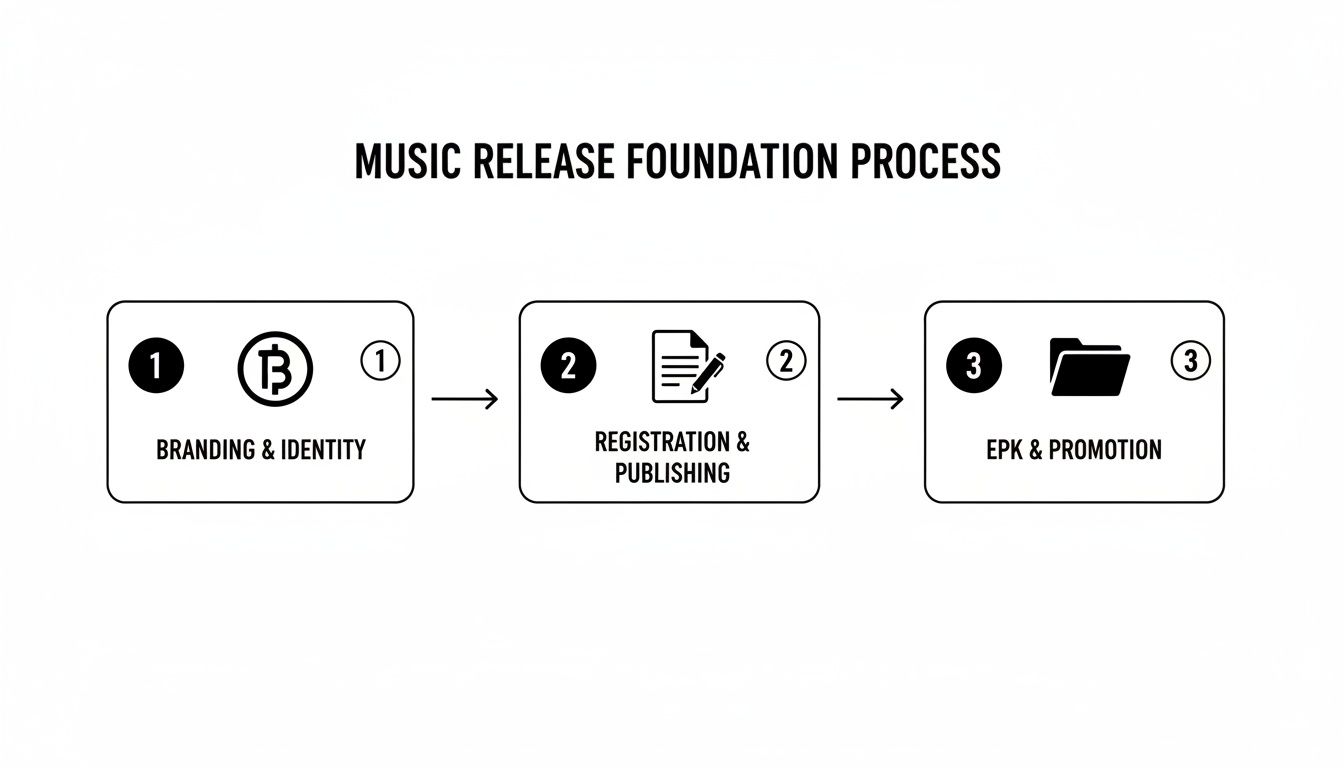
As you can see, it's a logical flow. A cohesive brand leads to proper registration, which then feeds into a killer press kit. Each step builds on the last.
To help you stay on track, I've put together a simple pre-release checklist. These are the must-do tasks to knock out in the 4-6 weeks before your release date to make sure everything goes smoothly.
Your Pre-Release Campaign Checklist
| Timeline | Task | Key Objective |
|---|---|---|
| 4-6 Weeks Out | Finalize Master & Artwork | Ensure high-quality assets are ready for distribution. |
| 4 Weeks Out | Register with PRO & Distributor | Secure your royalties and schedule your release. |
| 3 Weeks Out | Submit to Spotify Editorial | Pitch for official playlists via Spotify for Artists. |
| 2 Weeks Out | Build/Update EPK | Create a professional press kit for outreach. |
| 1-2 Weeks Out | Prepare Social Media Content | Create and schedule all promotional posts and videos. |
| Launch Week | Activate Promotion Campaign | Send EPK to contacts, run ads, and engage with fans. |
Following this timeline takes the guesswork out of the process and keeps you focused on what matters most at each stage. It's all about building momentum, not scrambling at the last minute.
Creating an Unforgettable Electronic Press Kit (EPK)
Your Electronic Press Kit (EPK) is your digital handshake. It’s a one-stop shop for bloggers, radio hosts, and playlist curators, giving them everything they need to feature you without a dozen follow-up emails. A messy or incomplete EPK is a quick way to get ignored. For a full breakdown of the release process, check out our guide on how to release music independently.
At a minimum, your EPK needs to include:
- Your Music: Private, streamable links to the new track (and maybe a few older ones).
- High-Resolution Photos: A few professional press shots and your single's cover art.
- A Compelling Bio: A short version (one paragraph) and a longer one (a few paragraphs).
- Key Links: Your website, socials, and main streaming profiles.
- Press and Accolades: Any cool quotes, past features, or awards you’ve racked up.
Getting Your Spotify-First Promotion Strategy Right
In today's game, Spotify isn't just another streaming service—it's the whole ecosystem. A "Spotify-first" mindset means you're using its own tools as the engine for your entire campaign, not just a place to dump your music. This whole approach is about focusing your energy where listener data directly fuels your reach.
Getting traction here isn't about getting lucky. It's about strategically triggering Spotify's algorithms and giving its human editors a reason to pay attention. Every time a listener saves your track or adds it to their personal playlist, they're sending a powerful signal to the platform that your music is connecting. Your job is to generate as many of those signals as you can, right from day one.
Mastering the Spotify for Artists Pitch
The single most important tool in your arsenal for landing on big playlists is the pitch feature inside your Spotify for Artists dashboard. This is your one shot to get your music in front of Spotify's editorial team, and you absolutely have to nail it. You need to submit your track at least seven days before it comes out, but honestly, give yourself 2-3 weeks in advance to be safe.
Your pitch has to be short, sweet, and to the point. Editors are swimming in thousands of submissions, so you need to hand them everything they need on a silver platter.
- Genre and Mood: Get specific here. Don't just say "Electronic." Call it "Melodic House" or "Lo-fi Beats." Pick moods that actually capture the vibe of the song.
- Instruments and Culture: Tag every instrument you can. If there's a specific culture or location tied to the sound, mention it. This is the kind of data that helps editors slot you into those perfect niche playlists.
- The Written Pitch: This is your moment. You've got less than 500 characters to tell the song's story. What was the inspiration? What makes it different? Mention your marketing plans, too—like a music video drop or a big social media push.
Think of your pitch as a business proposal. In just a few lines, you need to explain who you are, what the song is about, and why their audience is going to love it. Ditch the generic phrases and tell the real story behind your sound.
A well-written pitch shows you’re a professional and makes it easy for an editor to see exactly where your music belongs.
Fueling the Algorithmic Playlists
Editorial placements are great, but the real engine for sustainable growth comes from Spotify's algorithmic playlists. We're talking about heavy hitters like Discover Weekly and Release Radar, which are responsible for billions of streams. You can't pitch for these directly; you have to earn your way onto them.
The algorithm is watching for early signs of listener engagement, especially in the first few days after your release. The key metrics are:
- Saves: When someone saves your track to their library, it’s a huge vote of confidence. A high save-to-stream ratio tells the algorithm your song has legs.
- Personal Playlist Adds: A listener adding your song to their own "Workout Mix" or "Late Night Study" playlist is another massive signal.
- Follows: Getting listeners to follow your artist profile is critical. It guarantees your new music will appear in their Release Radar.
Your launch-week promotion needs to be completely focused on driving these actions. Get your existing fans on social media and your email list to save the track and add it to their playlists the second it drops. That early momentum is exactly what the algorithm needs to see before it starts pushing your music to new, similar listeners. For a deeper look, our guide on how to promote your music on Spotify breaks down even more tactics.
Running Targeted Spotify Ad Studio Campaigns
To give your organic growth a boost and feed the algorithm even more quality data, Spotify Ad Studio is a game-changer. It lets you run targeted audio and video ads to listeners on the free tier, and the key to success here is getting your targeting right.
Don't just blast your ad out to everyone. You can zero in on your perfect listener with incredible detail. Target users based on what they listen to, like fans of similar artists, specific genres, or even certain playlist categories. For example, if you just dropped a synthwave track, you can target people who are already streaming artists like The Midnight or playlists named "Retrowave Classics."
This makes sure every dollar you spend is reaching someone who is highly likely to actually vibe with your music. That means more quality streams, more saves, and more follows. This high-intent engagement feeds positive data back to the algorithm, creating a powerful feedback loop that keeps the discovery going.
Pitching to Playlists, DJs, and Music Blogs

While your Spotify campaign starts humming along, it’s time to get your hands dirty with some old-school outreach. Think of it as casting a wider net. Getting your music into the hands of DJs, bloggers, and independent playlist curators creates new ways for fans to find you, whether it’s on a late-night college radio show or a niche genre blog.
This is the manual, often tedious, part of the job. But the genuine connections you make here can pay off for years.
The game is more competitive than ever, but it's also more open. Independent artists are a huge force, and forecasts suggest they'll account for over 50% of music consumed on streaming platforms by 2025. The flip side? The money is still tight. A staggering 77.8% of independent artists make less than $15,000 from their music. You can dig into more of these stats over at 1stdropmusic.com.
What does that tell us? It means a scattergun approach won't work. You have to be smart and strategic, targeting the right people who will actually connect with your sound.
Finding the Right Curators and Outlets
The first and most important rule of pitching: do your homework. There's no point sending your new hyperpop track to a blog that only covers folk music. It’s a waste of your time and theirs. Your goal is to find people whose tastes genuinely line up with what you're making.
A great way to start is by looking at the world around artists who are in a similar lane as you.
- Dig Into Related Artist Playlists: See who's playlisting artists that sound like you. Are the curators independent tastemakers or are they tied to bigger publications? Note them down.
- Check the Credits on Music Blogs: When you find a review for a similar artist, see who wrote it. Many writers specialize in specific genres. Follow them.
- Explore College and Community Radio: These stations are goldmines for new music. They're often way more adventurous than commercial radio. Check their schedules online to find DJs hosting shows that fit your vibe.
Forget buying massive contact lists. Build your own targeted list in a spreadsheet. It’s all about quality over quantity here.
Crafting the Perfect Pitch Email
Your pitch email is your first impression, and you’ve got about ten seconds to make it a good one. Curators get hundreds of these a day, so yours has to be sharp, personal, and straight to the point. A sloppy, generic email is a one-way ticket to the trash folder.
Your entire goal is to make their job easy. Give them everything they need right away so they don't have to go searching for it.
The best pitches I've seen are always personal and direct. Use the curator's name, mention a specific playlist or article of theirs you actually like, and then explain in one sentence why your track is a perfect fit. It proves you're not just spamming a list.
Here’s a simple structure that just works:
- A Clear Subject Line: Keep it clean. "Music Submission: [Your Artist Name] - [Your Song Title] ([Genre])".
- The Personal Touch: Open with something that shows you know who you're talking to. "Hi [Name], I'm a big fan of your 'Midnight Drive' playlist..."
- The Quick Pitch: Give them a one-sentence hook. "My new single, 'City Lights,' is an atmospheric synthwave track with a modern pop feel, in the vein of artists like The Midnight or Timecop1983."
- Easy-Access Links: Provide a single private streaming link (SoundCloud is perfect for this) and a link to your EPK. That's it.
- A Polite Sign-Off: Thank them for their time and consideration.
Whatever you do, don't attach audio files or write a novel about your life story. Keep the entire email under 150 words. Your only job is to get them to click "play." A clean, professional email shows you're serious.
Driving Discovery on Social Media and TikTok
Let's be real: your music needs a visual and social heartbeat to even have a chance. Platforms like TikTok aren't just for announcing a new single anymore. They're where your song's story unfolds and where you turn passive listeners into actual fans.
The goal here isn't just to rack up followers; it's to build a genuine community. A killer social strategy for independent music promotions is less about yelling "listen to my new song!" into the void and more about showing people why they should even bother to click play.
The TikTok Discovery Engine
TikTok has completely flipped the script on music discovery. I've seen a 15-second clip of the right part of a song do more for an artist's career than a thousand-dollar ad campaign ever could. The trick is to stop thinking like a brand and start acting like a creator.
The algorithm doesn't care about polish; it rewards creativity and engagement. Your job is to find the catchiest, most "hooky" moment of your track and build a quick visual story around it.
Here are a few content ideas that consistently hit the mark for artists:
- Show the Process: Post the messy stuff. A quick clip of you struggling with a lyric, layering a harmony, or just goofing off in the studio makes you human.
- Tell the Story: What’s the song really about? Make a short video that visually captures the emotion or narrative behind your lyrics.
- Make It Interactive: Ask your followers a question, start a simple challenge, or use the duet feature to engage with others. This turns your music into something people can participate in.
If you're serious about building a presence, checking out some proven TikTok content ideas specifically for artists can give you a huge leg up. Authenticity is your most powerful asset—let people see the person making the music.
Amplifying Across Instagram and Beyond
While TikTok is amazing for getting discovered, platforms like Instagram are where you nurture that newfound community. You can absolutely repurpose your best-performing TikToks as Reels, but don't stop there. Use Instagram's other tools to pull people in closer.
Instagram Stories are perfect for driving direct action. On release day, use the "link" sticker to send followers straight to your Spotify profile. Polls and Q&A features are also gold for getting instant feedback and making your audience feel like they're part of the conversation.
Think of your social media as a funnel. TikTok is the wide top, catching new eyes and ears. Instagram is the middle, turning casual viewers into engaged followers. And your email list and streaming profiles? That's the bottom, where your true fans live.
The key is to be consistent and authentic everywhere you post. You don't need a massive budget for social media, but you do need creativity and persistence. For a deeper dive, our complete guide on how to promote music on TikTok breaks down even more tactics. At the end of the day, the most successful independent music promotions are built on real connections, and social media is where those relationships are forged.
Budgeting and Measuring Your Promotional Success
Smart indie music promotions run on two things: a solid financial plan and an honest look at what’s actually working. Let's break down budgeting and analytics. You don’t need a massive bankroll to make an impact, but you do need to spend strategically and track your results like a hawk.
This isn’t about throwing money at a campaign and crossing your fingers. It’s about making calculated moves that get results, whether you're working with fifty bucks or five thousand. Every dollar needs a job, and every action needs to be measurable.
Allocating Your Promotion Budget
There’s no magic number for a release campaign budget; it all comes down to your goals. Are you trying to get a debut single on the radar, or are you pushing for serious playlist traction on a follow-up? Your objective is what tells your money where to go.
This is especially true when you see the scale of the industry. The global recorded music industry pulled in $29.6 billion in 2024, with streaming accounting for a whopping 69% of all revenue. That reality means indie artists have to be incredibly sharp about how they fight for a piece of that pie on platforms like Spotify. You can dive deeper into these key insights from the 2025 music industry report to see the full picture.
Your spending should be a direct reflection of your main goal. A small, focused budget always beats a large, scattered one.
Let's look at a few real-world examples of how you might break down your spending.
Sample Promotion Budgets for Your Single
Thinking about how much to spend can be tough, so here’s a table to give you a clearer idea of what’s possible at different levels. Notice how the strategy shifts from pure discovery to a more diversified approach as the budget increases.
| Budget Tier | Total Spend | Allocation Breakdown (Ads, PR, Servicing) | Primary Goal |
|---|---|---|---|
| The Hustler | $50 - $250 | 100% on targeted social media ads (Meta/TikTok). | Driving initial streams and saves from a niche audience to trigger algorithms. |
| The Contender | $500 - $1,500 | 50% ads, 30% playlist servicing (like Club Restricted Promo), 20% blog outreach. | Securing a mix of algorithmic and independent playlist placements to grow monthly listeners. |
| The Professional | $2,000 - $5,000+ | 40% ads, 30% playlist servicing, 30% professional PR for high-tier blogs/radio. | Achieving widespread coverage, significant playlist adds, and a major boost in listener data. |
As you can see, the path is clear: start with a solid foundation of targeted ads to get the ball rolling. As your resources grow, you can start layering in other services to amplify your reach.
Defining KPIs That Actually Matter
It’s easy to get fixated on vanity metrics like the total stream count, but that can be a trap. A million streams from bot farms? Absolutely worthless. You need to focus on Key Performance Indicators (KPIs) that signal real fan engagement and tell the Spotify algorithm your music is connecting with actual people.
Don't get lost in the numbers. The story is in the engagement. A track with 10,000 streams and a 15% save rate is performing far better than a track with 100,000 streams and a 1% save rate. The algorithm knows the difference.
Here are the vital signs you need to be tracking obsessively in your Spotify for Artists dashboard:
- Monthly Listeners Growth: This is your overall reach. A steady upward trend shows your promo is consistently finding new ears.
- Playlist Adds: This tracks how many user-made and third-party playlists have added your song. It’s a direct measure of how much curators and fans are feeling your track.
- Save Rate: You can calculate this as (Total Saves / Total Listeners) x 100. A save rate north of 10% is a very strong signal to the algorithm that you've got a hit on your hands.
- Listener-to-Follower Conversion: How many people listening to your music actually hit that "Follow" button? This metric proves you're building a real fanbase, not just attracting drive-by listeners.
Using Data to Refine Your Strategy
Your analytics dashboard isn't just a report card—it's your roadmap for the next release. Once a campaign wraps up, dive into the data to see what hit and what missed. Did your Meta ads drive more saves than your TikTok campaign? Did one specific playlist placement cause a big spike in new followers?
Use this info to figure out your Return on Investment (ROI). If you dropped $100 on ads and got 50 new followers and 500 saves, you now have a baseline. Next time, you can try different ad creative or a new audience to see if you can beat those numbers.
This cycle of spending, measuring, and refining is the heart of successful independent music promotions. Every release becomes a learning opportunity, making your next campaign smarter, leaner, and way more powerful than the last.
A Few Common Music Promotion Questions, Answered
Trying to navigate independent music promotion can feel like you're learning a new language on the fly. You're juggling the creative side with the business side, and it's totally normal to have questions about where to put your time and money. This section is here to cut through the noise and give you some straight, actionable answers.
Think of it as a quick cheat sheet. The goal is to clear up the confusion and help you make smarter moves for your music.
How Far in Advance Should I Start Promoting My Music?
The sweet spot for kicking off your promotion is 4 to 6 weeks before your release date. This isn't just some random number; it's a strategic timeline that really sets you up for a successful launch. Starting this early gives you a comfortable cushion to get all the important, time-sensitive stuff done without a last-minute scramble.
For example, getting your track submitted for Spotify editorial consideration is a non-negotiable. They ask for at least a week, but giving them 2-3 weeks is a much better look and improves your chances. This window also lets you prep your social media content, start building some real hype with your listeners, and begin reaching out to blogs and playlist curators.
Starting your promo early is probably your biggest competitive advantage. It lets you build genuine momentum and deal with any unexpected hiccups from your distributor without the stress of a deadline breathing down your neck. A last-minute push almost never makes the splash you're hoping for.
Are Paid Playlist Promotion Services Worth the Money?
This is a tough one, because the real answer is: it depends. The industry has some legit services that can give you a real, organic boost. But it’s also full of scams pushing bot streams. Those fake plays can get your music flagged, penalized, or even pulled down from platforms like Spotify.
A service you can trust will always be transparent about how they work. They’ll be focused on pitching your music to actual human curators and will never, ever promise a specific number of streams. Before you spend a dime, do your homework.
- Look for Reviews: See what other artists are saying. What was their experience like?
- Ask for Case Studies: A real company will have no problem showing you past results.
- Be Skeptical of Promises: If it sounds too good to be true ("Guaranteed 50k streams!"), it definitely is.
Honestly, your budget is often better spent on targeted ads through Spotify Ad Studio or Meta, where you have total control over who you're reaching and can track every bit of engagement yourself.
What Metrics Should I Actually Track to Measure Success?
It's so easy to get obsessed with the total stream count, but that number alone doesn't tell you much. The metrics that really matter are the ones that show people are genuinely connecting with your music. These are the Key Performance Indicators (KPIs) that tell the Spotify algorithm your song is a winner.
Instead of just staring at the stream count, dig into these data points in your Spotify for Artists dashboard:
- Growth in Monthly Listeners: This shows your overall reach and how many unique people are checking out your music.
- Saves: When someone saves your track, it’s a huge signal. A key metric is your Save Rate (saves divided by listeners); anything over 10% is really solid.
- Playlist Adds: This tracks both curator and user interest, proving your song is finding a home in people's daily lives.
- Follower Count: This is your core fanbase. Turning a casual listener into a follower is the name of the game.
Also, pay close attention to where your streams are coming from. Are they from algorithmic playlists like Discover Weekly, user playlists, or your artist profile? This data tells you what's actually working in your campaign.
How Can I Promote My Music with No Budget?
A zero-dollar budget isn't a dead end—it just means you have to get creative and hustle a lot harder. Your entire focus needs to shift to organic growth and building real connections. This is where your time becomes your biggest investment.
Start by making killer short-form videos for TikTok and Instagram Reels that show off the best parts of your song. Get involved in relevant online communities on places like Reddit (in subreddits like r/IndieMusicFeedback) or genre-specific Discord servers where you can share your work and get honest feedback.
Another powerful move is to network with other indie artists for collabs and cross-promotions. You can give each other's releases a shout-out to your respective audiences. And finally, get your email pitch down and send personalized messages to smaller, passionate music blogs and independent curators. It’s a grind, for sure, but building a real fanbase from the ground up is way more valuable than paying for a bunch of fake streams.
Ready to amplify your reach and get your music heard by the right people? The team at Club Restricted Promo specializes in building strategic campaigns that deliver real results. Explore our targeted Spotify promotion packages and let's get your next release the attention it deserves. Find your perfect package at https://www.clubrestrictedpromo.com.