

What Are Royalties in the Music Industry A Complete Guide
Music royalties are how you get paid. Simple as that.
Think of it like owning a piece of real estate. Every time someone "uses" your property—whether it's streaming your song on Spotify, playing it on the radio, or featuring it in a movie—you're owed rent. These payments are the financial lifeblood for artists and songwriters, and understanding how they work is non-negotiable for a sustainable career.
What Are Royalties in the Music Industry?
At its heart, a music royalty is just a fee paid to the owner of a song for the right to use it. But to really get it, you have to start with the single most important concept in the music business: every recorded song is actually two different copyrights.
That’s right. Every track you hear is essentially two separate assets bundled into one: the composition (the song itself) and the master recording (the specific version you're listening to). This split is the entire foundation for who gets paid, what they get paid for, and how the money flows.
The Two Foundational Copyrights
The first copyright is for the composition. This is the song's DNA—the melody, the lyrics, the core musical structure. Think of it as the blueprint or the sheet music. It belongs to the songwriter(s) and their music publisher.
The second copyright is for the master recording. This is the actual audio file you hear, the specific performance captured in a studio. It belongs to the recording artist and, more often than not, the record label that funded the recording session.
To make this crystal clear, here’s a simple breakdown of the two copyrights that exist in every single song:
The Two Copyrights in Every Song
| Copyright Type | What It Covers | Who Typically Owns It |
|---|---|---|
| Composition | The song's melody, lyrics, and musical structure (the "song" itself). | Songwriter(s) and Music Publisher(s) |
| Master Recording | The specific recorded version of the song (the actual sound file). | Recording Artist(s) and Record Label(s) |
This dual-copyright system means one song has two sets of owners, and both need to get paid whenever the song is used. A cover song is the perfect example: the original songwriter still gets paid for the composition, while the new artist who recorded the cover gets paid for their master recording.
A common mistake new artists make is thinking they own everything just because they wrote and recorded a song. Understanding the split between the composition and the master is the first step to collecting all the money you’re owed.
The rise of streaming has completely changed the game, turning tiny payments from platforms like Spotify and Apple Music into the main source of income for most creators. It's not just pocket change, either. In a recent year, global royalty collections for music creators hit a massive €12.59 billion, with music making up 90% of all creator royalties worldwide.
You can learn more about this growth in the Global Collections Report 2025. This proves just how critical it is to get a handle on your royalty streams if you want to build a real career in music today.
Decoding the Different Types of Music Royalties
When you put a song out into the world, it doesn't just earn one paycheck. Think of it more like a piece of real estate that can be rented out in a bunch of different ways. Every time your music is played, copied, or used, it generates a specific kind of income stream. Nailing down what these are is the only way to make sure you're getting every dollar you've earned.
To really get what's going on with music royalties, you have to start with the two fundamental copyrights that exist for every track: the composition (the song itself—lyrics and melody) and the master recording (the actual audio file). Each one is a money-maker in its own right.
This map breaks down how both the song and the recording are the twin engines driving royalty payments.
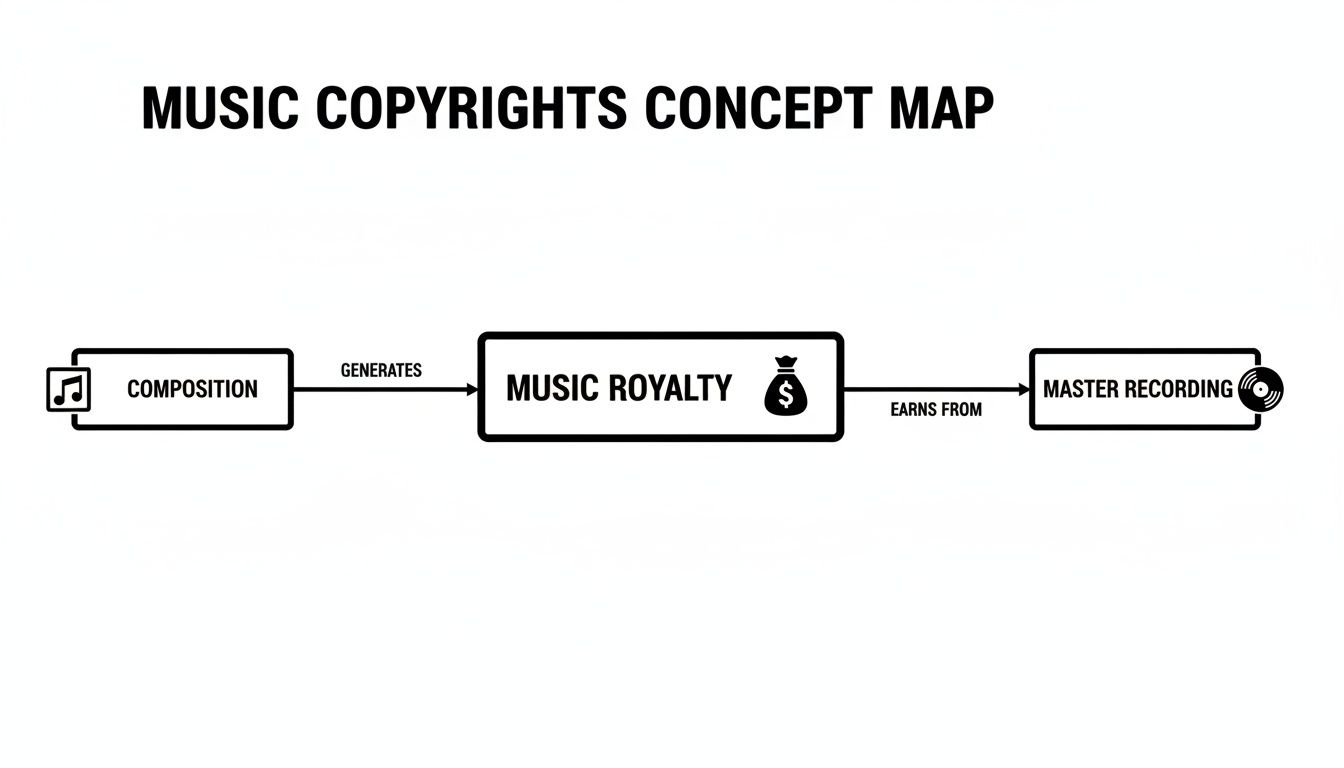
As you can see, royalties aren't a single thing. They're a whole collection of payments that flow back to the people who own these two core assets. Let's dig into each type.
H3: Mechanical Royalties: Getting Paid for Copies
First up: mechanical royalties. The name sounds super technical, but the idea is actually pretty simple. A mechanical royalty is paid to the songwriter and their publisher every single time a copy of their song is made.
Back in the day, this literally meant the "mechanical" process of pressing vinyl records or burning CDs. Today, the definition has grown to cover the digital world.
- Physical Sales: When a label presses 1,000 vinyl LPs, they owe mechanical royalties for each of those 1,000 copies.
- Digital Downloads: Every time someone buys your track on a store like iTunes, that’s considered a reproduction, and it kicks off a mechanical royalty.
- On-Demand Streaming: This is the big one now. When a fan streams your song on Spotify or Apple Music, it’s legally viewed as a temporary reproduction. Yep, that also triggers a mechanical royalty.
In the U.S., the rates for these are set by a government group called the Copyright Royalty Board (CRB) to keep things fair for songwriters.
H3: Performance Royalties: Getting Paid When Your Music is Broadcast
Next are performance royalties. These get generated anytime a song is performed "publicly." And trust me, the definition of "public" is way broader than you'd think. It covers way more than just a live concert.
Think of it as a fee paid to the songwriter and publisher for the right to play their work for an audience.
Performance royalties are the absolute lifeblood of a songwriter's income. They come from everywhere—a massive global radio hit, a song playing in the background of a coffee shop, you name it.
Here are the most common places you'll find them:
- Terrestrial Radio: Classic AM/FM radio plays are a huge source.
- Television: Songs used in TV shows, commercials, or even as the theme music.
- Live Venues: Any concert hall, bar, restaurant, or club that plays music has to pay up.
- Streaming Services: Digital "public performances" on platforms like Spotify, Pandora, and others count, too.
Organizations like ASCAP, BMI, and SESAC are the ones who track all these plays and collect the money for songwriters and publishers.
H3: Synchronization Royalties: Pairing Your Music with Visuals
Synchronization royalties, or sync royalties for short, are earned when your music is synched up with any kind of visual media. This is where things can get really exciting, especially for indie artists. A single sync placement can be worth thousands of dollars.
To make it happen, you need a "sync license," which is basically a permission slip to use the song. This usually involves negotiating an upfront fee. If you want to dive deeper into the paperwork, you can check out the basics of a licensing agreement for music.
Getting a great sync placement isn't just about the money; it can also give you massive exposure.
Common Sync Placements Include:
- Films and movie trailers
- Television shows and commercials
- Video games
- Online content (YouTube, TikTok, Instagram)
Because a sync deal needs permission for both the song and the recording, both the publisher/songwriter and the label/artist get a piece of the pie.
To help keep all these streams straight, here's a quick cheat sheet.
Music Royalty Types at a Glance
This table breaks down the main royalty types, what triggers them, and who usually gets the check.
| Royalty Type | Generated By | Who It Pays (Typically) |
|---|---|---|
| Mechanical | The reproduction of a song (physical sales, digital downloads, on-demand streams) | Songwriter & Publisher |
| Performance | Public broadcast or performance of a song (radio, TV, live venues, streaming) | Songwriter & Publisher |
| Synchronization (Sync) | Pairing music with visual media (films, TV shows, ads, video games) | Songwriter, Publisher, Artist & Label |
| Digital Performance | Plays on non-interactive digital radio (Pandora, SiriusXM) | Artist & Label (Master Recording Owners) |
| Neighboring Rights | Public performance of the master recording outside the U.S. (international radio, TV) | Artist & Label (Master Recording Owners) |
This overview makes it clear how each use of your music creates a distinct lane for revenue.
H3: Digital Performance and Neighboring Rights
Finally, let's talk about a couple of newer royalties that popped up with the digital age. Digital performance royalties are created when a song is played on non-interactive digital services, like Pandora radio or SiriusXM.
The key word here is "non-interactive"—the listener can't pick the specific song they want to hear. What makes these royalties so different is that they are paid to the owners of the master recording (that's the performing artist and the record label), not the songwriter.
Closely related are neighboring rights, which are basically the international version of digital performance royalties. They are performance royalties for the master recording that are collected from radio, TV, and public venues outside the United States. To get this money, artists and labels have to register with collection agencies in those countries.
The Gatekeepers Who Collect Your Royalties
Earning royalties is one thing, but actually getting that money into your bank account is a whole different beast. Think of the music industry’s financial system like a massive, complex network of pipes. Your royalties are the water flowing through, but without the right connections, that money will never reach you.
This is where collection societies—the industry's essential gatekeepers—come in. These organizations are the specialized accountants and financial plumbing that ensure creators get paid. You don't just upload a song and hope for the best; you have to actively partner with these groups to collect what you're owed. For any serious artist, getting affiliated is non-negotiable.
Performance Rights Organizations (PROs)
Every time your song is played on the radio, in a restaurant, at a concert, or streamed online, it generates a performance royalty. But how can you possibly track every single play around the globe? You can't. That’s the entire job of a Performance Rights Organization (PRO).
PROs like ASCAP, BMI, and SESAC in the United States act as your personal accounting firm for public performances. They issue licenses to thousands of businesses—from major radio networks to your local coffee shop—and collect fees from them. They then use sophisticated tracking to figure out when and where your songs were played, paying you the songwriter’s share of those earnings.
- Who they represent: Songwriters and music publishers.
- What they collect: Performance royalties for the composition (the underlying song).
- Why you need them: It is physically impossible to monitor and collect these royalties on your own.
Without a PRO, you are leaving one of the most significant and consistent streams of songwriter income on the table. Simple as that.
Mechanical and Collective Management Organizations (CMOs and MROs)
While PROs handle the performance side, a different set of organizations manages mechanical royalties. These are generated every time a "copy" of your song is made, which today includes everything from a vinyl pressing to an on-demand stream on Spotify.
In the U.S., the most important player here is The Mechanical Licensing Collective (The MLC). This organization was established by law to collect digital mechanical royalties from streaming services (like Spotify and Apple Music) and pay them directly to songwriters and publishers. A Collective Management Organization (CMO) is a broader term you'll see outside the U.S., often acting as a one-stop-shop for multiple royalty types.
Think of The MLC as a dedicated pipeline built specifically for streaming mechanicals. If you’re an independent songwriter with music on streaming platforms, registering your works with The MLC is absolutely essential to claim these earnings.
These groups make sure that for the millions of streams happening daily, the right songwriters and publishers are getting paid for the reproduction of their work.
Music Publishers and Record Labels
Finally, you need to understand the roles of your primary business partners: music publishers and record labels. These aren't just collection societies; they are active stakeholders in your copyrights who play a huge part in royalty collection.
A music publisher is your champion for the composition (the song you wrote). Their job is to administer your songwriting copyright, register your songs with all the necessary collection societies worldwide, and hunt down opportunities to get your music placed in films, TV, and ads. If you want a deep dive on what they do, our guide on how to publish your music breaks it all down.
A record label, on the other hand, invests in and typically owns the master recording. They are responsible for collecting royalties generated by that master—like earnings from digital streams, physical sales, and sync fees for the recording itself. They then pay the artist their contractually agreed-upon percentage after recouping their expenses.
Knowing who collects what is the key to unlocking your full earnings potential. It’s the difference between being a hobbyist and running a business.
How Music Royalties Are Calculated and Paid
Okay, so you know the types of royalties and who collects them. Now for the most important part: following the money.
This is where we get into how your creative work actually turns into a paycheck. Understanding the math behind the splits, calculations, and payouts is the key to building a sustainable career.
It all starts with the standard industry splits. For the composition copyright—the actual song you wrote, the melody and lyrics—the revenue is almost always split right down the middle.
- 50% goes to the songwriter(s). This is called the "writer's share."
- 50% goes to the music publisher(s). This is the "publisher's share."
This 50/50 agreement is the bedrock of music publishing. If you're an indie artist acting as your own publisher, you're entitled to 100% of that composition money. The catch? You're also responsible for collecting both halves, which is a job in itself.
Unpacking Advances and Recoupment
When it comes to master recording royalties for artists signed to a label, things get a bit more complicated. Two words you absolutely must understand are advances and recoupment. These terms are the engine room of most modern music industry contracts.
Think of an advance as a loan from the label, paid out against your future earnings. It’s that upfront cash designed to cover recording sessions, marketing pushes, and even your rent while you create. But it's not a gift—it’s recoupable.
This means the label has to earn back, or "recoup," every single dollar of that advance from your share of the royalties before you see another cent from sales or streams. If your advance was $50,000, you won't get any royalty checks until your music has generated $50,000 for the label.
An advance can feel like a big payday, but it’s crucial to remember that it’s your own future earnings being paid to you early. Managing this money wisely is essential for long-term financial health.
This system is exactly why you hear stories of artists with hit songs who are still "broke." They might have millions of streams, but if the advance and marketing costs were high, they're still unrecouped.
The Reality of Streaming Calculations
So, how does a single stream turn into actual cash? The math can be pretty sobering.
While the exact rate is always changing, a simplified per-stream payout is around $0.003. It looks tiny, and it is. The real challenge, though, is how many different ways that fraction of a penny gets sliced up before it ever reaches you.
A big part of understanding these calculations is knowing the basics of licensing music for commercial use, since that's what triggers these payments in the first place.
From that single $0.003 stream, a piece of the pie goes to:
- The Record Label (for the master recording)
- The Recording Artist (their cut from the label, after recoupment)
- The Songwriter(s) (for the composition)
- The Music Publisher(s) (also for the composition)
- Collection Societies (PROs, The MLC, etc., who take a small admin fee)
This complex chain of payments shows why volume is everything. The split between the master recording and the composition is also telling. On average, about 63% of streaming revenue goes to the master rights holders (artists/labels), with the remaining 37% going to the composition side (songwriters/publishers).
This is why strategic promotion isn’t just a nice-to-have; it’s essential. Driving millions of streams through targeted campaigns is the only way to make those micro-pennies stack up into real, meaningful income.
How to Maximize Your Royalties with Strategic Promotion
Knowing the different royalty types is step one. But the real goal? Making those royalty checks bigger. This is where smart, strategic promotion comes in. It’s not just about getting heard—it’s about getting heard in the places that actually pay you.
Think of promotion as the engine driving your royalty machine. Every single thing you do to market your music, whether it's a targeted playlist campaign or pitching a track for a TV show, directly creates more plays, more reproductions, and ultimately, more money in your pocket.
Turn Streams into Substantial Income
Let's be real: streaming is king right now. A well-run Spotify playlisting campaign can put your music in front of millions of new listeners. And while each stream is only worth a fraction of a cent, those tiny payments stack up fast when you get real volume.
Every one of those streams triggers two crucial royalties:
- Mechanical Royalties: Paid to you as the songwriter for the "copy" of your song.
- Performance Royalties: Paid for the public "performance" (the stream itself) on the platform.
A single great campaign that gets your song on a few major playlists can easily rack up millions of streams. Suddenly, those micro-royalties aren't so micro anymore—they become a serious, recurring income stream. To really make this happen, you need to get serious about promotion. You can check out an in-depth guide to music promotion services that can help grow your audience and push those stream counts up.
Target High-Value Royalty Streams
Streaming is your foundation, but other types of promotion can unlock much bigger, lump-sum payments. Focusing some of your energy on these avenues can give your earnings a massive boost and diversify your income.
Sync Licensing for Film, TV, and Social Media
Getting your music placed in a movie, a hit TV show, a video game, or even a viral TikTok trend generates synchronization (sync) royalties. A single sync placement can pay anywhere from a few hundred bucks to tens of thousands of dollars upfront, plus you get backend performance royalties every time it's aired. Pitching your music to music supervisors and sync agents is a direct shot at this incredibly lucrative income.
Radio and DJ Promotion
Don't sleep on the old-school channels. A solid radio campaign or getting your track into the hands of influential DJs still generates powerful performance royalties. PROs like ASCAP and BMI are tracking these public broadcasts and paying you for them. It’s a classic for a reason—it still works.
"So many indie artists get hyper-focused on streaming that they completely forget about other massive income sources. A single well-placed sync license or a regional radio hit can earn more than millions of streams combined. If you want a stable career, you have to diversify your promo efforts."
Think Globally to Maximize Earnings
Your audience isn't just in your hometown, and neither are your royalties. One of the smartest financial moves you can make is building an international fanbase. The global music market is blowing up, with huge growth happening in places outside of North America and Europe.
Global recorded music revenues have been climbing for years, mostly driven by streaming. But check this out: public performance rights make up 9.7% of total revenues, and sync rights for media hit $650 million. Markets like Brazil (up 21.7%) and Mexico (up 15.6%) are turning into royalty goldmines.
When you promote your music internationally, you’re tapping into these growing markets. You start earning performance royalties, mechanicals, and neighboring rights from every corner of the globe. This strategy is what turns your music from a local hustle into a global business.
Your Essential Checklist to Claim Every Royalty
Alright, knowing what royalties are is one thing. Actually getting that money into your bank account is a whole different game.
Think of it this way: without checking off these boxes, your music could be earning cash that’s just sitting in an account somewhere, waiting for you to claim it. This isn't just boring paperwork—it's the business foundation that turns your art into a career.
Let's walk through the exact steps you need to take. Each one closes a loophole where your money could leak out, making sure every stream, radio spin, and sale is counted.
Step 1: Lock Down Your Composition Royalties
First things first: you have to register and protect your composition—the actual song itself (the melody and lyrics). This is the source of all your songwriting money, so you absolutely cannot skip this.
-
Join a Performance Rights Organization (PRO): As a songwriter, you must sign up with a PRO like ASCAP or BMI. They are the only ones who can track down and collect your "writer's share" of performance royalties when your song is played on the radio, on TV, in a bar, or streamed online. This is step one for a reason.
-
Register Every Single Song with Your PRO: Just having an account isn't enough. You have to log in and manually register every song you write, making sure to include who wrote what (the splits). If a song isn't in their system, it's invisible. It won't earn you a dime.
-
Get a Publishing Administrator: A publisher or publishing administrator's job is to chase down the other half of your money—the "publisher's share" and all your mechanical royalties. Services like Songtrust or Sentric basically act as your publishing team, registering your music all over the world to collect money you physically can't get by yourself.
Quick reminder: Your PRO only collects half of your performance money (the writer's share). Without a publisher or an admin, the entire publisher's share and all your mechanical royalties are almost certainly being left on the table.
Step 2: Secure Your Master Recording Royalties
Okay, now for the other side of the coin. The royalties from your specific recording of the song are a totally separate stream of income and need a different set of registrations.
Join SoundExchange and Get a Distributor
-
Sign up with SoundExchange: This is non-negotiable. SoundExchange collects digital performance royalties from non-interactive services like Pandora and SiriusXM radio. This is money paid directly to the main artist and the owner of the master recording. Your PRO does not collect this.
-
Pick a Digital Distributor: To get your music onto Spotify, Apple Music, and everywhere else, you need a distributor like TuneCore or DistroKid. They are the ones who collect the master recording royalties from these platforms and pay them out to you.
-
Get Your Metadata Perfect: When you upload your tracks, the metadata—song title, artist name, ISRC codes, writer names, and splits—has to be 100% accurate and consistent everywhere. Bad metadata is the #1 reason royalties get lost in the system. Treat it like you’re mastering the final track. It's that important.
A Few Common Questions We Hear About Royalties
Alright, let's cut through the noise. The world of royalties can feel like a maze, so let's tackle some of the most practical questions artists ask. Getting these basics down can make a world of difference for your career.
Seriously, How Long Until I Get Paid?
This is the big one, right? The honest answer: it’s not fast. You’ve got to be prepared for a delay.
Your Performance Rights Organizations (PROs)—think ASCAP or BMI—usually pay out every three months. But here’s the catch: there's often a six to nine-month lag between when your song gets played on the radio and when that money actually hits your bank account. Digital distributors are a little quicker, paying out monthly or quarterly, but even they have a two or three-month delay.
Why the wait? Imagine the sheer volume of data. Platforms like Spotify have to process billions of streams, figure out who gets a piece of each one, report it all, and then send the money down the line. It just takes time.
Key Takeaway: Royalty payments are never instant. You absolutely have to plan your finances around these delays to stay afloat.
Do I Really Need a Music Publisher?
Short answer: yes, if you want to collect all your money. You can get your "writer's share" of performance royalties directly from your PRO without much fuss. But collecting the "publisher's share" and all your mechanical royalties? That's a whole different beast.
This is where a music publisher or a publishing administrator comes in. It’s literally their job to register your songs all over the world and chase down those specific royalties for you, and they take a percentage for their work. For most independent artists, using a publishing admin is the only realistic way to make sure you’re not leaving a ton of cash on the table—especially from international streams.
Can I Get Royalties for a Cover Song I Recorded?
This one trips people up. For a cover song, you cannot earn any songwriting royalties. Not a cent. Those belong entirely to the original songwriters and their publishers. In fact, to even release a cover legally, you have to secure a mechanical license and pay royalties to them.
But here’s the good news: you absolutely earn royalties from your master recording of that cover. You are the performer and the owner of that specific recording. That means every royalty generated from streams and sales on the master side belongs to you.
At Club Restricted Promo, we turn your music into a stream-generating machine. Our targeted Spotify campaigns are built to grow your audience and, in turn, your royalty checks. Start your promotion campaign today and maximize your earnings.