

A Guide to Music Industry Contracts
Music industry contracts are the legal documents that map out the business relationships between artists, labels, producers, and everyone in between. These aren't just a bunch of formalities; they are the foundational blueprints for your career. They dictate everything from how you get paid to who owns your music.
Why Music Contracts Are Your Career's Blueprint
Think of a music contract less like a restrictive legal document and more like the architectural plan for your professional life. You wouldn't build a house without a detailed blueprint, and you shouldn't build a music career without understanding the agreements that hold it all together. This is where verbal promises become legally binding commitments.
A solid contract gives you clarity and security. It answers all the tough questions upfront—the ones that can lead to ugly disputes and lost money if you leave them unanswered. On the flip side, signing a contract you don't fully understand can mean giving up your creative rights and future income. This is especially critical when you're learning how to release music independently, because you're often acting as your own business manager.
The Core Purpose of a Music Contract
At their heart, every music contract does a few key things. It formalizes the partnership, making sure everyone is on the same page about their roles, responsibilities, and how the money gets split. This isn't just about protecting yourself; it's about building a professional foundation so everyone can work together without things getting messy later.
These agreements spell out the specific terms of the deal, including:
- Ownership: Who actually owns the master recordings? What about the song itself?
- Compensation: How will the profits be divided? This covers royalties, advances, and other fees.
- Term: How long does this agreement last, and what happens when it’s over?
- Obligations: What is each person expected to deliver? This could be a certain number of songs, marketing support, or tour dates.
A contract turns your music from a passion project into a sustainable business. It locks in ownership, clarifies how you get paid, and protects your name so you receive the credit you deserve for your work.
Navigating the Legal Landscape
Let's be real—the language in these documents can feel dense and intimidating, packed with industry jargon. But skimming over the details is one of the biggest mistakes an artist can make. Clauses covering things like recoupment, exclusivity, and rights assignment can impact your creative and financial freedom for the rest of your life.
For example, a sneaky exclusivity clause could stop you from collaborating with other artists or signing a side deal for years. An unfavorable rights assignment might mean you sign away ownership of your master recordings forever.
This guide is here to demystify this world. We’ll break down the essential agreements and clauses you’ll run into so you can walk into negotiations with confidence, ask the right questions, and lock in deals that actually support your vision.
The 6 Most Common Music Contracts Explained
Walking into the world of music contracts can feel like trying to read a foreign language. But here’s the thing: each one is just a tool designed for a specific job in building your career. Getting a handle on the main types is your first real step toward making smart calls about who you partner with, how you get paid, and who controls your art.
These six agreements are the foundation of almost every artist's business.
This blueprint shows how every deal you sign pulls levers on your partnerships, earnings, and creative control.
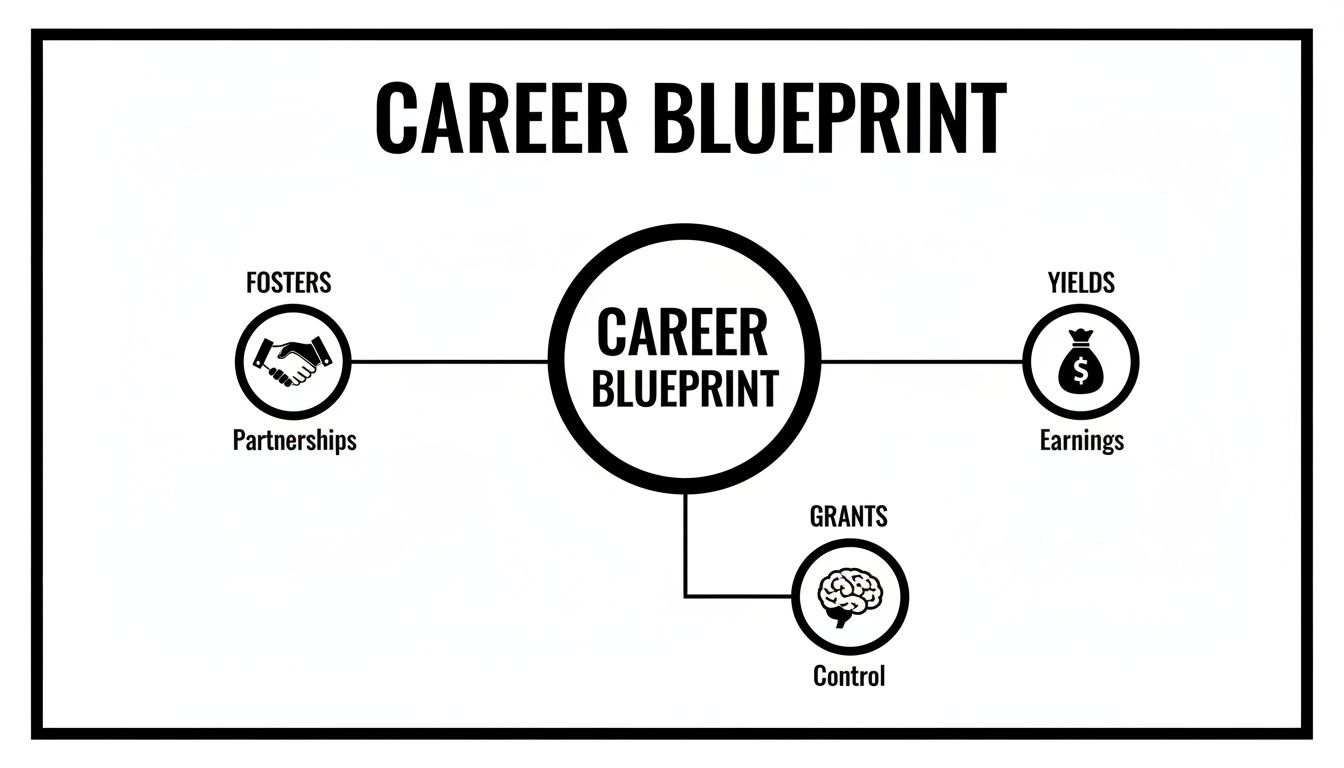
Think of it this way: every contract is a negotiation between these three core pillars. Your career is shaped by how you balance them.
1. The Record Deal
This is the classic "getting signed" fantasy. In a traditional record deal, a label fronts you a financial advance to make an album and cover your bills. The catch? In exchange, the label usually owns the master recordings—the actual sound files of your songs—forever.
The label then handles the heavy lifting: manufacturing, distribution, marketing, and promotion. You won't see a dime in royalties until the label has recouped every penny they spent from your share of the profits.
While these deals are getting more flexible, the core idea is still label investment for ownership. The Taylor Swift saga with her old masters is a perfect, high-profile example of how artists can lose control of their life's work. That whole situation sparked a huge industry shift, and by 2025, hybrid deals offering artists better terms jumped by 40%.
2. The Distribution Deal
For artists who want to keep ownership of their masters (and you probably should), a distribution deal is the go-to. Think of a distributor as the UPS for your music. You pay them a fee or a small cut to get your tracks onto Spotify, Apple Music, and into stores.
They don't own your work; they just ship it. This path gives you way more control and a much bigger slice of the royalties, often around 85%. The trade-off is that you’re on the hook for funding the recording and marketing yourself. It’s a simple equation: more risk and work for more control and a higher potential reward.
3. The Publishing Agreement
A record deal is about the final recording (the "cookie"), but a publishing deal is all about the song itself—the "recipe" of lyrics and melody. A music publisher is basically your song's agent. Their entire job is to get your compositions placed in movies, TV shows, ads, and video games, then hunt down and collect all the royalties you're owed.
When you sign a publishing deal, you're giving the publisher a piece of your copyright ownership in exchange for their work and usually an advance. They then hustle to make that song earn as much money as possible.
Before you can do any of that, you have to get your songs registered correctly. Our guide on how to publish your music breaks down exactly how to handle that crucial first step.
4. The Management Agreement
This contract lays out the ground rules between an artist and their manager. Your manager is the CEO of your career. They advise on every business move, help you build your team (agent, publicist, lawyer), and keep you focused on the long-term vision.
Typically, a manager takes a 15-20% commission on an artist's gross earnings. It is absolutely critical that this contract spells out exactly which income streams they can commission and for how long. The right manager is a game-changer, but a fuzzy contract is a recipe for disaster.
5. The Producer Agreement
A producer agreement is the deal you make with the person who shapes the sound of your record in the studio. This contract locks in the producer's fee, their "points" (a percentage of royalties from the record's sales), and any ownership they might get in the master recording. It’s all about making sure they're paid fairly for their creative magic and that everyone knows who owns what from day one.
6. The Sync Licensing Agreement
A synchronization (or "sync") license is what gives someone permission to use your music in visual media—a film, a TV show, a commercial, you name it. These are usually one-time deals where a "music supervisor" pays a fee to both the owner of the master (the label or artist) and the owner of the composition (the publisher or songwriter).
In an era where streaming pays fractions of a penny, sync licensing has become a massive and essential source of income for artists. One good placement can change everything.
Key Clauses That Can Make or Break Your Career
The real power of any music contract isn’t on the fancy letterhead or in the flashy advance number. It's buried deep in the legal language—the nitty-gritty clauses that define the entire relationship. These are the terms that can either launch your career into the stratosphere or trap you in a deal that suffocates your creativity and your bank account.

Think of it like learning the rules of a game before you step on the field. You absolutely have to know what you're signing. Overlooking these details is a rookie mistake you can’t afford to make.
Term and Options
The Term is the lifespan of the contract—the initial commitment period. In a record deal, this often isn't measured in years but in albums or EPs. For example, your initial term might be for one album.
But here’s where you need to pay close attention: the Options. These give the label or publisher the unilateral right to extend your deal. You get no say. If they decide to "pick up your option," you're locked in for another album or period.
A deal structured as "one album firm, plus six one-album options" is really a seven-album deal if, and only if, the label wants it to be. You're on the hook, but they can walk away after each project.
Advances and Recoupment
Getting an advance feels amazing. It’s that upfront check that lets you quit your day job and hit the studio. But here's the reality: an advance is not a gift. It's a loan against your future royalties.
And that brings us to recoupment. Before you ever see a royalty check, the company has to earn back, or "recoup," 100% of the money they've spent on you. This isn't just the advance. It's a running tab that often includes:
- Recording Costs: Studio time, producers, mixing, mastering.
- Video Production: The entire budget for your music videos.
- Tour Support: Money they fronted to get your band on the road.
- Marketing and Promotion: Often, a percentage of these costs are recoupable.
Think of it this way: the label gave you a business loan to create your music. They get paid back first from your share of the profits. Until that debt is zeroed out, your royalty account is "in the red."
Grant of Rights and Exclusivity
This clause is arguably the heart of the entire contract. The Grant of Rights spells out exactly what assets and permissions you are giving away. For a record deal, this is usually ownership of your master recordings. For a publishing deal, it’s a percentage of your song's copyright.
Since so many deals are built on copyright, having a baseline understanding copyright law is a massive advantage. The wording here can be the difference between licensing your work for a period and signing it away forever—"in perpetuity."
Tied directly to this is Exclusivity. This clause means that for the entire term of the deal, your services belong exclusively to them. You can't just go record a single for another label. You often can't even appear as a guest vocalist on another artist's track without getting written permission first.
Royalty Splits and Accounting
Your royalty rate is the percentage of income you get. For a new artist, this might be anywhere from 12% to 18%, but it’s always negotiable. Critically, this percentage only applies after the label has fully recouped all its expenses.
But a great rate means nothing if the accounting is shady. Your contract must clearly define:
- Payment Frequency: How often do you get paid? It's usually semi-annually.
- Statements: You must receive detailed statements breaking down every dollar earned and every expense deducted.
- Audit Rights: This is your right to hire your own accountant to inspect the company's books. Without this clause, you have no power to challenge their numbers if something looks wrong. It is non-negotiable.
Controlled Composition Clause
This is an old-school, tricky clause that still pops up in modern record deals, and it can seriously slash your earnings as a songwriter. A Controlled Composition is any song on the album that you wrote or co-wrote.
This clause typically does two nasty things:
- It forces you to license your songs to your own record label at a discount—usually 75% of the standard mechanical royalty rate.
- It puts a cap on how many songs the label will pay you for, typically 10 per album.
So, if your album has 12 songs you wrote, you earn nothing for those last two. Worse, if you co-wrote with someone who isn't subject to the clause, their full royalty gets paid out of your capped amount, which can leave you with pennies or even nothing. Fight this one hard.
To make this easier to digest, here's a quick cheat sheet for the most important clauses you'll encounter.
Essential Contract Clauses Explained
| Clause Name | What It Means | What to Watch For |
|---|---|---|
| Term & Options | The length of your initial commitment and the company's right to extend it. | A short initial term with many, long option periods. This gives them all the power. |
| Advance & Recoupment | The upfront "loan" you get and the process of the company paying it back from your royalties. | A long list of recoupable expenses. Try to make things like videos only 50% recoupable. |
| Grant of Rights | What you're giving away—copyrights, master recordings, your likeness, etc. | "In perpetuity" language, which means forever. Aim for a limited term of ownership. |
| Exclusivity | You can only provide your services (recording, writing) to this company during the term. | Overly restrictive language that prevents you from doing features or side projects without permission. |
| Royalty Rate | Your percentage of the income after recoupment. | Low rates (<15%) and deductions for packaging, foreign sales, or "new technology." |
| Accounting & Audits | How and when you get paid and your right to inspect their financial records. | Vague accounting terms or a missing audit clause. This is a massive red flag. |
| Controlled Composition | A clause that reduces the mechanical (songwriter) royalties the label pays you. | Any mention of a reduced rate (75%) or a cap on the number of paid songs per album. |
Getting familiar with this language is your first line of defense. Knowing what these clauses mean puts you in a much stronger position to negotiate a deal that actually helps you build a sustainable career.
How Music Deals Evolved From 360 to Artist-Friendly
The music industry is always changing, and the contracts that hold it together are no different. The deals artists are signing today are a world away from what was on the table just a couple of decades ago. This isn't just a history lesson—it gives you the context you need to know what a fair deal actually looks like right now.
Think of it like this: music contracts follow trends, just like fashion or tech. Those trends are usually pushed by huge shifts in how we listen to music and how artists build their careers. By tracing the line from the old-school, restrictive “360 Deal” to today's more flexible options, you’ll be in a much better spot to negotiate a contract that actually helps you win long-term.
The Rise of the 360 Deal
The early 2000s were chaos for major labels. The digital boom, kicked off by services like Napster, completely wiped out physical album sales. Labels had to scramble to find a new way to make money, and their answer was the 360 Deal. It was an all-in contract designed to give them a piece of every single dollar an artist made.
Basically, the label became a shareholder in "You, Inc." They weren't just taking a cut of your record sales anymore. They wanted a percentage of everything:
- Touring and concert revenue
- Merchandise sales
- Publishing and songwriting royalties
- Sponsorships and endorsement deals
- Acting or appearance fees
This was a direct reaction to album sales falling off a cliff. The trend really took off after the 2008 financial crisis, but it started back in the Napster days. Labels were facing insane losses from piracy—peaking at 30 billion illegal downloads a year by 2006. So, giants like Universal, Sony, and Warner rolled out 360 contracts that claimed 20-50% of an artist’s total income, not just music. A 2024 IFPI report even noted that 85% of major-signed artists were on these deals, trying to pay back advances from $200k to $2M with royalties as low as $0.0039 per Spotify stream. You can dig deeper into this global music revenue shift on hypebot.com.
A Power Shift Towards Artists
While 360 Deals are still out there, the game has changed. A lot. The explosion of independent artists, armed with distribution platforms and social media, has forced the entire industry to evolve. Artists simply don't need a major label anymore to record, release, and promote their music to a global audience.
This new leverage has created an era of much more artist-friendly deals. Today, the landscape is all about flexibility and choice. You can build a custom team and a deal structure that actually fits what you need, instead of being forced into a one-size-fits-all box.
The modern artist is a business owner, and the new wave of music contracts reflects that reality. The power dynamic has moved from total label control to a more collaborative partnership model.
The New Age of Artist-Friendly Contracts
Today's music deals are way more diverse. Artists can now pick and choose the exact services they want, which means they keep more control and a much bigger slice of the pie. This has made a few new models incredibly popular.
Key Artist-Friendly Models:
- Distribution-Only Deals: This is as indie as it gets. You keep 100% ownership of your master recordings and just pay a distributor a small fee or percentage to get your music on Spotify, Apple Music, and everywhere else. You run your own marketing, but you keep almost all the money.
- Label Services Agreements: Think of this as an à la carte menu. You can hire a company for specific services you need—like radio promotion, digital marketing, or PR—without signing away your rights. You only pay for what you use.
- Profit-Split Deals: This is a true partnership. The artist and the label both invest in a project, and after all the costs are paid back, they split the profits. It's often a 50/50 split, creating a scenario where everyone shares the risk and the reward.
This evolution is fantastic news for creators. With a smart strategy, you can build a successful career entirely on your own terms. Using the best music promotion services can give you the push you need to make the most of these better deal structures. Knowing this history gives you the power to walk into any negotiation with strength, ready to demand a partnership that respects you and your art.
Negotiation Strategies and Red Flags to Avoid

Let’s get one thing straight: signing a music contract is a business deal, not an act of surrender. The single best way to protect your future is to walk into that room prepared.
Remember, the contract they slide across the table is just their opening offer. It’s their wish list. Your job is to make it work for you.
Your power at that table comes from one thing: leverage. And leverage isn't about being loud or aggressive; it's about having options. Before you even think about talking deals, you should be focused on building your own foundation—a loyal fanbase, solid streaming numbers, and a clear brand. When you can prove you bring real value, you earn the right to ask for what you’re worth.
Literally everything in a contract is up for discussion. The royalty split, how long the deal lasts, who pays for marketing—it's all on the table. For a deeper dive, check out these powerful contract negotiation strategies that apply far beyond just the music biz.
Smart Moves at the Negotiation Table
The right mindset is everything. You're not just trying to get a deal done; you're trying to secure a good deal that actually helps your career. That takes patience and a rock-solid understanding of what you want before the conversation even starts.
Here are a few core strategies to keep in your back pocket:
- Never, Ever Accept the First Offer: It's standard procedure for the first draft to be heavily skewed in the company's favor. Your job (or your lawyer's) is to pull it back to the middle ground.
- Negotiate the Big Stuff First: Zero in on the deal-breakers. We're talking ownership of your masters, the contract term, royalty rates, and how recoupment works. These are the clauses with the heaviest financial impact.
- Know Your Worth (and Bring Receipts): Come armed with data. Show them your streaming analytics, social media engagement, and ticket sales. Cold, hard proof of your value is your strongest negotiation tool.
The most powerful phrase in any negotiation is a polite but firm "no." Being willing to walk away from a bad deal gives you ultimate control over your career.
The Top 5 Red Flags to Watch For
While a great music lawyer is your best line of defense, you still need to be able to spot the most common predatory clauses yourself. If you see any of these, pump the brakes and start asking hard questions. They're often signs of a lopsided deal that could haunt you for years.
Here are the biggest red flags in music contracts:
- Vague or Ambiguous Language: If a clause about money, expenses, or what you’re obligated to do is confusing, it’s probably confusing on purpose. Demand crystal-clear language on every single point.
- “In-Perpetuity” Ownership: Any phrase that gives a company ownership of your copyrights or masters “in perpetuity” means forever. This is a career-defining commitment and should almost always be negotiated down to a limited term.
- Cross-Collateralization: This is a nasty but common accounting trick. It lets a label use the profits from your hit album to pay off the debts from an unsuccessful one, making it incredibly difficult for you to ever see a dime in profit.
- No Audit Rights: The contract must explicitly state that you have the right to audit the company’s books. If it doesn’t, you have zero way to verify if their royalty statements are accurate. This is non-negotiable.
- Unreasonable Delivery Requirements: Watch out for terms demanding an unrealistic number of “commercially and technically satisfactory” songs. This subjective wording is a classic trap used to keep artists locked in deals indefinitely if the label isn't happy.
Your Pre-Signing Checklist: The Final Gut Check
Alright, stop. Before that pen even thinks about touching the paper, we need to do one final gut check. This isn't just a list; it's your last line of defense against a bad deal.
Think of this as the pre-flight check before you launch the next stage of your career. It’s about making a clear-headed decision, not an emotional one, and avoiding the kind of mistakes that can cost you dearly down the road.
Legal and Financial Sanity Check
Have you really gone through this thing with a fine-tooth comb? So many artists rush this part, and it’s where the most damaging mistakes happen.
- Lawyer Up: Has a real music attorney—not your cousin who does real estate law—reviewed every single word of this contract? This is non-negotiable. See it as an investment in your career, not an expense.
- Explain It Back to Me: Can you explain the Term, what rights you're giving away, how the royalties work, and what recoupment actually means in your own simple words? If you can't, you're not ready to sign.
- Do the Math: Have you actually mapped out how the advance and all the recoupable costs will eat into your earnings? You need to understand, realistically, when you might actually start seeing royalty checks.
The Long-Term Reality Check
A contract isn't just about today. It locks you in for years, shaping your entire future. You need to be brutally honest with yourself about the commitment you're making.
Never sign a document that defines your future without first understanding every possible outcome. Your signature is your bond—make sure it’s one you can live with.
- What's the Exit Strategy? When this deal is over, what happens? Do you get your masters back, or does the company own them for life? This is a huge one.
- Where Are the Statements? Does the contract clearly state you'll get regular, detailed accounting statements? You need to see the numbers.
- Can You Audit Them? Is your right to hire an accountant and check their books spelled out? Without that clause, you have zero power to question their math if something looks off.
Your Top Questions About Music Contracts, Answered
Even after you get a handle on the basics, a few specific questions always come up when it's time to actually look at a contract. Let's tackle the most common ones artists ask so you can walk into any negotiation with a bit more confidence.
Do I Really Need a Music Lawyer to Look at This?
Yes. Non-negotiable. Think of it this way: the label or publisher paid their lawyers to draft a contract that benefits them, not you. A music attorney isn't a luxury; it's a critical investment in your career.
An experienced music lawyer knows the industry inside and out. They can instantly spot a bad clause, tell you what's standard versus what's predatory, and fight to get you a deal that won’t come back to haunt you. The money you spend now could save you hundreds of thousands—or the rights to your entire life's work—down the road.
What’s the Single Biggest Mistake Artists Make?
The number one mistake, hands down, is signing a contract without truly understanding the Grant of Rights and the Term. Artists get excited about an advance check and completely miss the part where they're signing away their master recordings or publishing rights forever—"in perpetuity."
This isn't just a small detail. It can mean you lose the ability to re-record your own songs, control how they're used in movies or ads, and collect royalties from them for the rest of your life. Always, always know what you're giving away and for how long.
This trap is so common because the language is designed to be confusing. But the consequences are permanent. Before your pen ever touches that paper, get crystal clear on who owns what and for how long.
Can I Just Get Out of a Bad Contract?
Escaping a signed music contract is incredibly difficult and expensive. Once it's signed, it's legally binding, and your options for getting out are slim to none.
You can’t just change your mind. Usually, your only hope is to prove the other side completely failed to hold up their end of the bargain—what's called a "material breach."
Here are the rare (and tough) ways it can happen:
- Breach of Contract: You'd have to prove they violated a major part of the deal, like refusing to release your music or failing to pay you correctly according to the contract's own terms.
- Renegotiation from Leverage: If you suddenly become a superstar, you might have enough power to force them back to the table to renegotiate. But don't count on it.
The best move? Don't sign a bad deal in the first place. Do your homework, ask the hard questions, and get a legal expert on your side before you sign anything.
Ready to build your career on your own terms? Club Restricted Promo provides the tools you need to grow your audience and make an impact. Explore our Spotify promotion packages and start your campaign today.